TechnoSpore® in Aquafeed—A Holistic Approach to Improving Fish Production.
The intricate ecosystem of gut microbiota is a central element in the mechanism of health, disease, and productivity. While the scientific community has made significant progress in the knowledge of the microbiota of many animals, our understanding of fish microbiota is not as robust. Nevertheless, research has shed light on the critical role that the gut microbiota plays in the well-being, performance, and biological functions of fish.
Factors that affect the gut microbiota.
The unique microbial composition within an individual fish is shaped by a combination of selective pressures exerted by the host, diet, and environmental conditions. The relative contributions of the different factors influencing the microbiota are still unclear. Studies of fish diets and gut microbiota have shown the gut microbiota is associated with different dietary patterns, feed, and nutrients.
It has been noted that replacing fishmeal with plant-based protein results in a significant reduction in the diversity of the gut microbiota. The type of protein fed can also affect the microbiota. For instance, replacing plant proteins with poultry by-product meal results in increased protein degrading microbes in rainbow trout.
The effects of dietary lipids on the intestinal microbiota of fish have also been investigated. Vegetable oils with different fatty acid compositions had a significant effect on the abundance and diversity of gut microbes and fish fed with saturated fatty acids had greater gut microbial diversity. Furthermore, the abundance of Pseudomonas spp. was found to be elevated in fish fed a high saturated fatty acids diet, and fish oil supplementation limited the growth of Pseudomonas spp.
The environmental factors influencing wild fish microbial communities are mainly related to water quality and chemistry. Studies with Atlantic salmon transitioning from freshwater to seawater have shown that the change in salinity causes a dramatic change in the microbiota. This could also be a reason for the reduced feed intake and overall performance during this transition phase.
The influence of water temperature on the fish intestinal microbiota is an important question as well, as fish can face increased or decreased water temperature due to seasonal changes. It has been noted that cold stress reduced the diversity, and composition of the intestinal microbiota of blue tilapia. When the microbial response of cold-resistant and cold-sensitive fish were compared, the microbiota of cold-resistant fish was more resilient to temperature changes. As such, water temperature acts as an influencing environmental factor.
Effects of the Intestinal Microbiota on the Host.
In a fascinating display of biological interplay, commensal bacteria regulate many key aspects of the host in a mutualistic relationship. The gut microbiota is considered an important factor in the regulation of nutrition and metabolism in fish and can regulate many key aspects of host functions involving feeding behavior, energy balance, nutrient metabolism, and immune response.
For example, gut microbes promote energy absorption by the host and regulate the expression of genes involved in energy and lipid metabolism. It is also proposed that the microbiota of herbivorous fish can convert dietary carbohydrates into short chain fatty acids, which play an important role in host nutrition and health.
Gut microbes are essential for maintaining the development and maturation of the immune system. Gut colonization in zebrafish was found to induce the expression of genes related to innate immune responses and to activate transcription factors like NF-κB in tissues, supporting the role of the microbiota in immune regulation. Early colonization of the gut microbiota by certain bacterial species was required for normal neurobehavioral development in zebrafish.
In tilapia, the use of probiotics was found to activate gut microbial changes consistent with activation of the endocrine system, including increased expression of insulin-like growth factor genes. The insulin-like growth factor system is involved in the regulation of cell growth and differentiation, proliferation and survival, and is responsible for healthy growth in juveniles.
TechnoSpore®.
Microbial probiotics can be sorted into two main categories—spore-forming and lactic acid producing bacteria. Each has its benefits. Spore-forming microbes are easier to handle and process when they are in their spore-stage. Furthermore, some produce digestive enzymes to improve feed conversion and are especially known to inhibit gram-positive pathogenic bacteria.
Lactic acid bacteria are quick to become active in the gut compared to other probiotics. These bacteria are prolific producers of lactic acid, which improves the overall gut environment, and are known to reduce gram-negative pathogenic bacteria.
There is one species of bacteria that combines the best of both—Bacillus coagulans. This is currently the only known probiotic that is both spore-forming and produces large amounts of lactic acid. This means that this probiotic is easy to handle, but also provides gram-positive and gram-negative bacterial inhibition, digestive enzyme production, and overall improvement of the intestinal environment. Bacillus coaglans is known to have positive effects on the gut morphology across numerous species, of not only swine and poultry, but also of fish and shrimp.
Biochem’s unique strain of this exceptional probiotic, B. coagulans DSM32016, also known as TechnoSpore®, is the first B. coagulans registered in the EU for pig and poultry nutrition and remains the only one available for this use.
Dietary Effects of TechnoSpore® on Nile tilapia.
Due to the expansion of intensive aquaculture and the worsening of water physiochemical features, disease outbreaks have become increasingly prevalent in farmed fish—including Nile tilapia (Oreochromis niloticus) as one of the most prominent fish in global aquaculture. Probiotic administration, including Lactobacillus spp., Bifidobacterium spp., and Bacillus spp. have become valuable tools in facing these challenges.
Due to the importance of tilapia as an aquaculture species, a 14-week feeding trial was conducted to determine the effects of TechnoSpore® supplementation on the growth performance, body composition, gut morphology, immunological response, and antioxidant status of Nile tilapia.
Healthy Nile tilapia fingerlings were randomly assigned to one of three groups: Control (basal diet without supplementation), BC1 (basal diet + 1 g TechnoSpore® with 2.5 x 10⁹ CFU/kg diet), or BC2 (basal diet + 2 g TechnoSpore® with 5 x 10⁹ CFU/kg diet). Each group consisted of five replicates of ten fish each in glass aquariums. Fish were fed to apparent satiation at 8:00, 13:00 and 16:00 h daily. The rearing conditions and water physiochemical characteristics were maintained at optimal conditions for tilapia.
At the end of 14-weeks, fish supplemented with TechnoSpore® (BC1 and BC2) had significantly higher final biomass, cumulative body gain, and average daily growth (P < 0.001) compared to the control group (Figure 1A; 1B). In addition, TechnoSpore® supplemented fish had improved meat quality with significantly higher protein and lower fat content (Figure 1C; 1D).
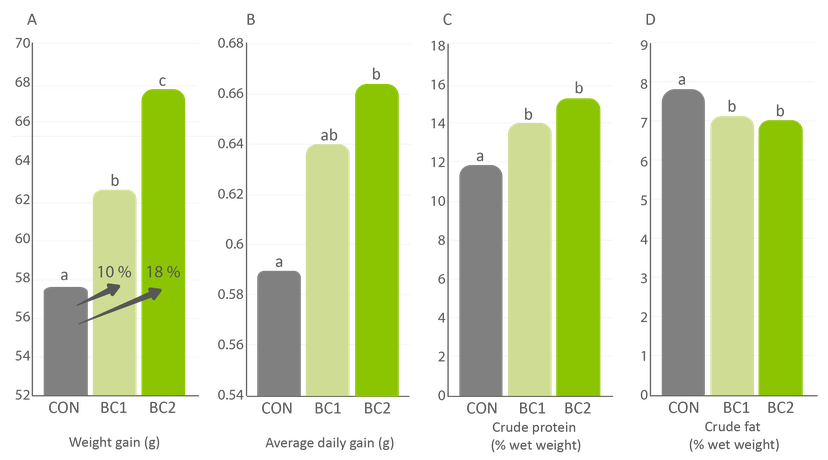 Figure 1: (A) Weight gain increased by up to 18 % with TechnoSpore® supplementation with (B) significantly increased ADG (P < 0.001). Meat quality was improved with (C) significantly higher protein and (D) lower fat content when tilapia were supplemented with TechnoSpore®. Different letters denote statistical significance between the groups; P < 0.001; n = 5.
Dietary B. coagulans supplementation significantly improved intestinal villus characteristics. Fish supplemented with TechnoSpore® had significantly increased villus height (P < 0.001) with significantly decreased crypt depth (P < 0.05). Additionally, the ratio of villus height to crypt depth was significantly increased in supplemented fish (P < 0.001; Figure 2).
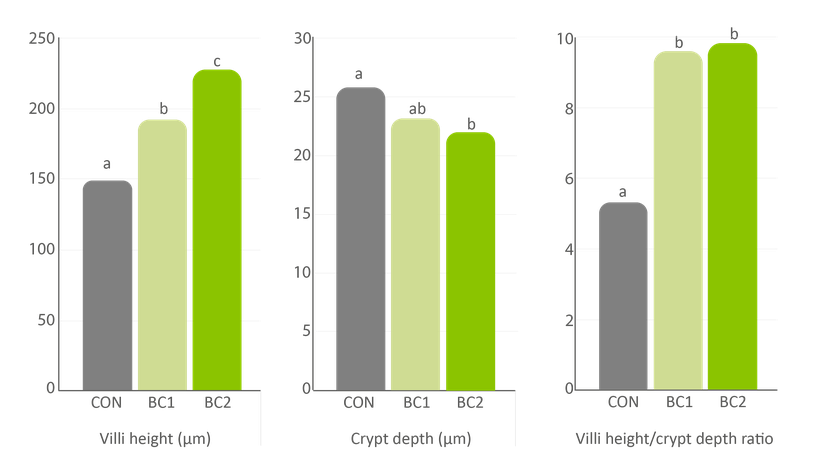 Figure 2: Histological analysis of the gut epithelium showed significant improvements of the gut morphology with (a) elongated villi (P < 0.001), (b), shallow crypts (P < 0.05) and (c) a beneficial villi hight to crypt depth ratio (P < 0.001) in fish fed TechnoSpore® supplemented diets. Different letters denote statistical significance between the groups; n = 5.
When assessing the small intestine, the relation of villus height to crypt depth is considered a primary indicator of development, health, and functionality. Villi play a fundamental role in the digestion and absorption of nutrients, and crypts are the region where new intestinal cells are formed.
Therefore, the ideal morphology is long villi with shallow crypts. Long villi are associated with increased absorption area, better digestive enzyme action, and improved nutrient transport. Shallow crypts reflect the longer survival of the villi without the need for renewal, which in this study may have resulted in less energy being required for villus renewal. The saved energy could be used for other tissue- or body growth.
B. coagulans supplementation significantly increased serum antioxidant activity and immunological responses as determined by malondialdehyde (MDA) and lysozyme levels. Under stressful conditions, the production of reactive oxygen species is increased, causing lipid peroxidation and cell membrane damage.
Malondialdehyde is one of the end products of lipid peroxidation in cells. Thus, an increase in free radicals increases MDA production, making MDA levels a marker of oxidative stress and antioxidant status. Fish fed diets containing TechnoSpore® had lower MDA levels (P < 0.01) compared to the control group (Figure 3).
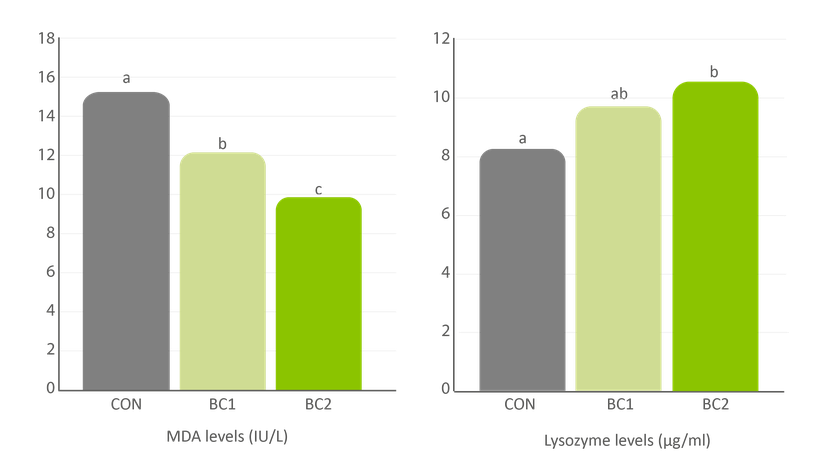 Figure 3: Treatment with TechnoSpore® decreased the marker of lipid peroxidation (MDA; P < 0.01) and positively influenced levels of lysozyme—an immune response marker (P < 0.05). Different letters denote statistical significance between the groups; n = 5.
Lysozyme is an antimicrobial enzyme produced as part of the innate immune system. It is a small protein that kills bacteria by lysing their cell wall, breaking down bacterial membranes, and activating autolytic enzymes in the bacterial cell wall. Supplementation with B. coagulans significantly increased this marker of immune response (P < 0.05), indicating an increase in cellular immune activity and better protection against diseases (Figure 3).
Dietary supplementation with TechnoSpore® B. coagulans improves Nile tilapia growth performance through improved intestinal morphology. Furthermore, supplementation of TechnoSpore® increases disease resistance by promoting immune response and improved antioxidant capacity.
Healthy gut microbiota supported by TechnoSpore® is proving valuable in promoting a balanced community of gut microbes that can significantly improve gut morphology, which results in fish growth, disease resistance and overall well-being. By supporting a healthy gut ecosystem, TechnoSpore® unlocks the full potential of fish health and performance.
References:
Fath El-Bab et al. 2022 doi: 10.3389/fvets.2022.1011715


