Early Nutrition for Calves: How it works best
Optimizing the rearing of young animals has become increasingly important in recent years. High-quality and intensive rearing has proved to be the right approach for the development of healthy and high-performing ruminants. But what are the key factors for successful rearing? What is the best way to ensure the optimal performance of animals in a labor and cost-efficient calf rearing system? Which feeding aspects should be given special attention? And how do these aspects influence calf development and health?
Early passive immunization: Why is it important?
The first hours of a calf’s life are crucial for its development and long-term health. A calf is born without a fully developed immune system and is therefore dependent on high-quality colostrum. In addition to providing life-essential immunoglobulins, colostrum stimulates the young animal's immune system and intestinal development. An early colostrum intake is important because both the quality of the colostrum and the absorption capacity of the animal decrease during the first hours of life. After just a few hours, the intestinal barrier of the calf will get impermeable to the important immunoglobulins. The establishment of colostrum banks and the use of colostrum enhancers have proven to be effective means of ensuring long-lasting colostrum availability and quality. Colostrum enhancers contain valuable supplemental immunoglobulins, vitamins and trace elements. The use of prebiotics and probiotics in the colostrum enhancer is also recommended to promote the development of the intestinal microbiota.
The risks of an inadequate developed digestive system.
In the first weeks of life, a calf’s digestive system is not fully developed. As a result, the young animal is dependent on easily digestible nutrients. The rumen has yet to develop and the protein-splitting enzymes in the abomasum are initially used for the digestion of milk proteins. In addition to whole milk, milk replacers are used in the rearing and fattening of calves. Along with milk proteins, various vegetable proteins are also used. In the first weeks of life, vegetable proteins can only be partially absorbed by the calves and thus entail a higher risk of diarrhea. In general, intensive feeding with 7-8 liters per day is a good basis for further development.
The transition to solid feed is gradual for the calves. In the first days of life, newborn calves should be provided solid feed components. In practice, a dry TMR (total mixed ration) consisting of special concentrates and finely chopped straw, or hay is often used. This combination ensures a better energy supply and improves rumen development. Access to sufficient fresh water is a basic requirement for feeding calves from the first day on. The supplementation of trace elements, vitamins as well as prebiotics and probiotics also plays an important role in the milk feed and in the calf's TMR.
Dysbioses and diarrheal diseases - The main problems in calf rearing.
The risk of diarrhea is especially high in the first four weeks after a calf’s birth. This is because the animal’s gastrointestinal tract and immune system are not yet fully developed. Early diarrhea is often associated with an increase of one or more enterotoxigenic Escherichia coli (ETEC) in the calf’s gastrointestinal tract. From the first week on, cryptosporidia and rotaviruses or coronaviruses are the main problems that harm young animals. To minimize diarrhea, it is especially important to reduce the number of pathogens and strengthen the immune system. The use of prebiotics or probiotics in calf rearing is a promising approach of counteracting dysbiosis (microbial imbalance) in the intestine. This displaces undesirable pathogens and promotes positive microorganisms to strengthen the microbial balance in the gastro-intestinal tract.
The use of functional feed components.
In recent years, hydrolyzed yeast products have become established as a viable approach to overcome the above-mentioned challenges in calf rearing. The most commonly used yeast strains are Saccharomyces spp. The best known and most widely researched of these is the strain Saccharomyces cerevisiae. In addition to this strain, Kluyveromyces fragilis has also received increasing attention for its use as a functional feed material. Hydrolyzed yeasts supply useful components from the cell wall and the cytoplasm of the yeast cell. These components have a positive effect on the development and function of the intestinal physiology and therefore on the growth performance of calves.
The hydrolysis process helps to improve the functionality of various yeast components, including nucleic acids, specific amino acids and yeast cell wall components. The hydrolysis also helps to improve the digestibility of the yeast components, e.g., the yeast protein.
The active yeast cell wall components of the hydrolyzed Kluyveromyces fragilis are mainly mannan-oligosaccharides and β-glucans. Mannan-oligosaccharides help to protect the animal against pathogenic germs by binding these in the intestinal tract. β-glucans contribute to an immune-stimulating effect in the intestine. These functions are of high importance due to the low immune defenses of young calves at the beginning of their lives. At the same time, these cell wall components have a prebiotic effect. They promote beneficial microbial colonization in the intestinal tract and thus have a positive impact on intestinal morphology and functionality.
Nucleic acids from the cytoplasm of the yeast serve as a source of nucleotides. These are especially beneficial for the development of tissue with a high rate of cell replication. They also support the intestinal functionality and immune defense of calves. As nutrient components, the hydrolyzed Kluyveromyces fragilis contains significant amounts of highly digestible proteins and a favorable amino acid profile. Due to the limited digestive capacity of young calves, this is a crucial requirement that contributes to optimal growth performance.
The positive effects of hydrolyzed yeast on intestinal development and functionality can significantly reduce diarrhea in calves. This can be proven with comprehensive documentation (Figure 1).
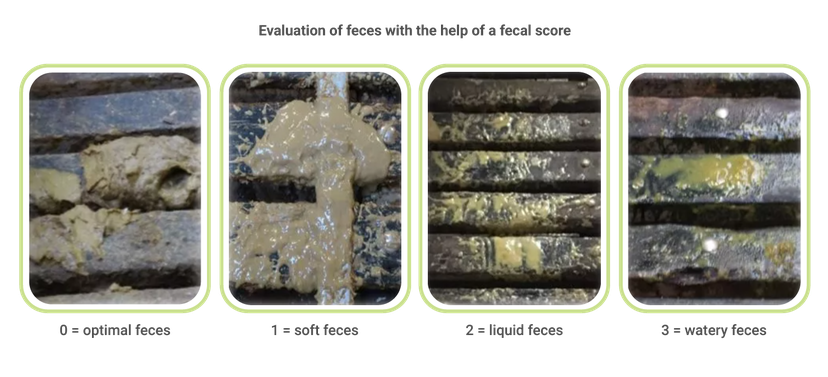
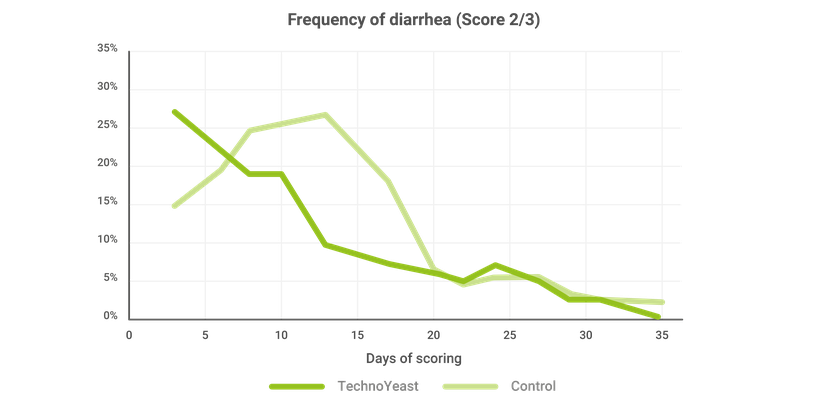 Figure 1: Diarrhea frequency in calves with an average age of 15-21 days supplemented with or without the hydrolyzed yeast TechnoYeast which is based on the strain Kluyveromyces fragilis. In this test, TechnoYeast reduced the frequency and severity of diarrhea. Biochem Research, 2019.
Hydrolyzed yeast products can be used in milk replacers as well as in the calf TMR. A positive impact of the yeast product on the development of rumen microbiota can be expected when it is used in the calf TMR. This supports the calf in its development into a ruminant.
Conclusion.
Calves have to overcome a number of critical phases on their way to healthy and productive ruminants. At the beginning of their lives, the animals suffer from a weak immune system and underdeveloped digestive functioning. This results in digestive disorders, diarrhea and lower weight gain. Concerning the development of intestinal physiology, nutrient digestibility and immunity in calves, hydrolyzed yeasts, such as TechnoYeast, are a good way to support calves in their first weeks of life. Improvements in feed intake and growth performance, as well as a reduction in the risk of digestive disorders have been documented in a large number of feeding trials.


