Time to Rethink Weaning: Why Smarter Strategies Deliver Stronger Biological and Economic Outcomes in Dairy Calves.
Young dairy animals shape the future productivity of every herd. Their successful rearing determines not only the genetic progress of the operation but also its long-term economic sustainability. However, the period from birth to first calving is often viewed as merely a cost center instead of the long-term investment in the future of the herd that it truly is.
It is expensive to raise dairy heifers from birth to their first calving. They do not generate income until their first lactation period. Overfeeding and underfeeding can both drive up costs in different ways. Too much feed puts unnecessary strain on the budget, while too little delays first calving and extends the non-productive period. Focusing solely on short-term expenses when considering early-life management misses the bigger picture because well-managed heifer rearing is one of the most impactful investments a dairy farm can make in terms of future performance and productivity.
The True Cost of Raising Replacements.
Several studies have quantified the cost of raising a dairy heifer from birth to first calving. These costs vary widely depending on the production system, region, and breed. In the United States, the average cost per animal is reported to be $1,803 ± $339. Simulation models estimate the cost to be $1,919 for barn systems, $1,594 for dry-lot systems, and $1,336 for pasture-based systems. In the Netherlands, the cost is approximately €1,790 per heifer. In Brazil, estimates range from $1,821 ± $44 for intermediate systems to $2,006 ± $63 for lower-performing operations. The upper tier averages $1,885 ± $63.
Significant investments are made in calf rearing from birth to weaning, particularly in high-quality milk replacers and starter feeds. These account for roughly 40–50 % of total rearing costs. However, attention often declines around the time of weaning, even though this is a critical transition period that strongly influences long-term health, growth, and future productivity. Inadequate management during this stage can undermine the returns on early investments by compromising the gains achieved during the initial and cost-intensive rearing period.
A Critical Phase: Weaning.
Weaning is one of the most significant yet underestimated milestones in calf rearing. It marks the transition from milk to solid food, which challenges the calf’s digestive, immune, and behavioral systems. Mistakes during this period can undermine months of careful management and lead to long-term consequences.
Between 12 % and 35 % of live-born calves never reach their first calving. Of those that do, 17 % fail to complete a second lactation. Overall, approximately one-third of replacement calves do not contribute positively to herd profitability. Even among surviving animals, nutritional management and weaning practices have long-lasting effects. Consistent underfeeding or abrupt weaning results in cumulative productivity losses across multiple lactations, leading to lifetime milk yield deficits of 800 – 1,500 kg per cow. This corresponds to a 5 – 8 % reduction in total milk yield and shorter herd longevity by about 0.15 years (roughly 55 days).
Pre-Weaning Growth: The Most Economical Growth.
Feed conversion efficiency is highest during the first 2 months of life, typically ranging from 2.0 to 2.5:1 (for milk and starter feed), making early growth the most economical phase of development (Figure 1). When managed properly, the significant investment in milk replacers and starter feeds are worthwhile as they are efficiently converted into growth.
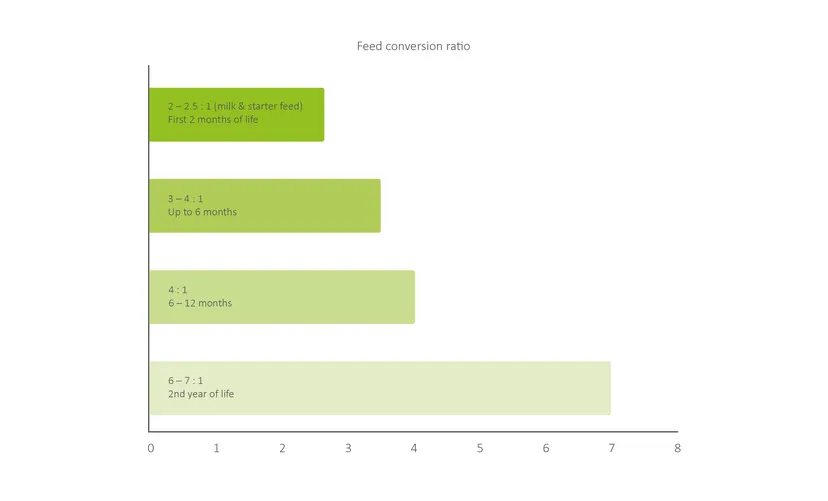 Figure 1: Calves are most efficient at converting feed in the first 2 months of life. After weaning, however, feed efficiency declines. Therefore, post-weaning setbacks are difficult and expensive to overcome.
At the same time, the cost per kilogram of daily weight gain is lowest in the first two months after weaning, provided that the weaning process is smooth. This makes the period economically interesting as well. However, poor weaning can increase rearing costs and limit future revenue potential by constraining early growth and milk yield, leading to a potential loss of up to $880 per cow (Table 1). This is because the early advantage can be lost if the transition to solid feed and the following months are not managed correctly.
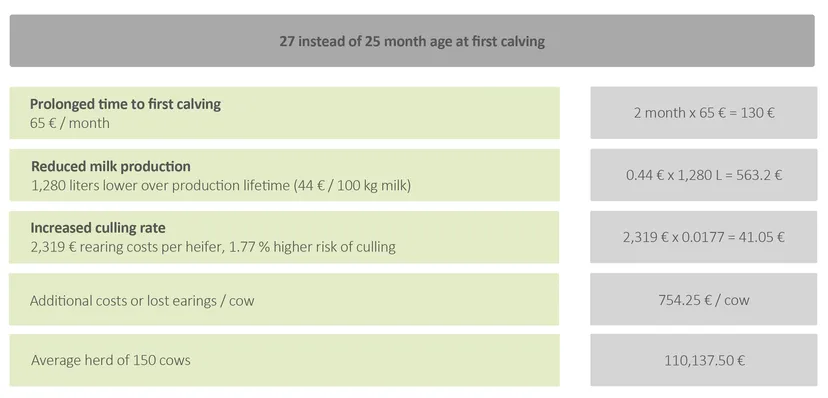 Table 1: Costs/losses incurred when increasing the age at first calving from 25 to 27 months.
A 2016 meta-analysis showed that pre-weaning ADG is a strong predictor of first-lactation performance. Calves that grew by only 0.5 kg per day before weaning produced the least amount of milk, fat, and protein during their first lactation. In contrast, faster-growing calves produced around 1,000 kg more milk. A 2025 meta-analysis confirmed this pattern, showing that higher daily gain and feed intake before weaning resulted in 3 – 5 % higher first-lactation yields—about 800 – 1,000 kg more milk—compared with calves weaned too early or too abruptly.
These results highlight that lifetime performance is shaped by early-life development and that dairy producers can influence this “early-life programming” through balanced nutrition and proper weaning management. It is crucial that the expensive gains made before weaning are not lost during the weaning phase. A smooth transition from liquid to solid feed minimizes the post-weaning energy gap, which results in slowed growth and increased costs.
The Economic Levers.
The main biological and management factors that influence the economics of rearing are ADG, age at first calving (AFC) and the herd replacement rate. Research shows that an AFC of around 24 months optimizes lifetime productivity. Calving too early—particularly when heifers have not reached adequate body weight—can compromise mammary development and reduce first-lactation milk yield. Conversely, delaying calving beyond 27 months extends the non-productive period and total rearing costs.
However, body mass, rather than age, is the primary factor in determining the appropriate time for first insemination. In dairy heifers, the optimal time for the first insemination is typically reached at 400–420 kg live weight and a withers height exceeding 135 cm. Therefore, avoiding growth slumps after weaning and optimizing growth rates before puberty also shortens the time to reproductive maturity and first conception, improving overall herd profitability.
Ultimately, the return on investment from birth to first lactation is often not fully realized until the end of the first lactation. This makes it crucial to minimize inefficiencies throughout the entire rearing period—especially during weaning when growth, feed efficiency, and future performance are most at stake (Table 2).
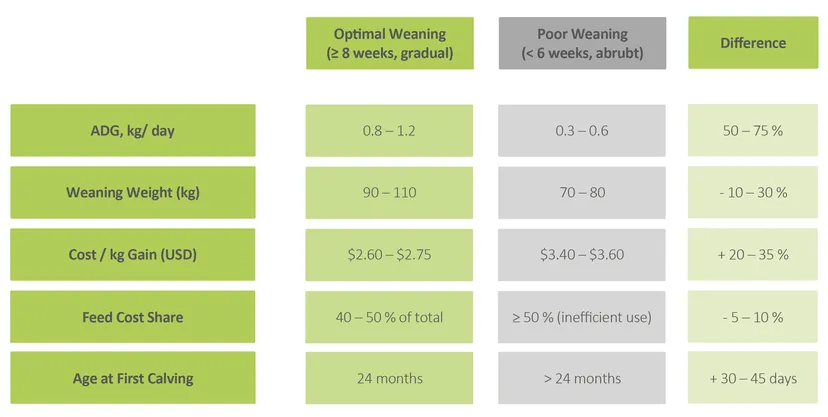 Table 2: The effects of weaning on ADG, weaning weight, cost per kg gain, feed costs, and age at first calving.
The Long Reach of Poor Weaning.
Several factors can lead to poor weaning. Weaning strategies that promote energy deficiency in calves should be avoided. These include:
Weaning calves too early, too quickly, or too abruptly, especially when transitioning from a diet high in milk
Insufficient starter intake at the time of weaning (too low energy intake).
Calves that are fed too much or only roughage
Providing unsuitable starter feeds, such as rations with overly high starch levels or low palatability
Other causes of poor weaning include inadequate or poor-quality water, social stressors, and excessive physiological stress around the time of weaning, particularly ruminal acidosis and mycotoxin contamination of the feed. Ruminal acidosis in weaning calves is common but often goes unrecognized.
Acidosis is triggered by starter feeds that are high in starch and low in neutral detergent fiber. Additionally, feeding regimens involving starters with small particle size, or incorrect texture, including grounded feed or pellets-only, increase the risk of ruminal acidosis, which is further exacerbated by limited or no access to fiber, which is ideally mixed with the starter feed. Typically, the signs of acidosis are not visible before weaning, but they become evident shortly after. Signs include small, skinny calves with rough hair coats, reduced feed intake, diarrhea, abdominal discomfort, decreased growth, and malabsorption and maldigestion. Furthermore, rumen acidosis activates the immune system, requiring three to four times more energy and diverting energy and nutrients away from growth.
Mycotoxins represent a similarly important and frequently underestimated challenge during weaning. Subclinical exposure can impair gut integrity, reduce feed intake, weaken immune function, and amplify the impact of other stressors—ultimately compounding the risk of growth checks and health problems during the transition.
Weaning calves can be supported through this critical phase by:
Supporting feed efficiency and nutrient availability
Promoting rumen development
Reducing immune-compromising factors, such as the impact of mycotoxins
Improving rumen conditions
Supporting immune function to improve resilience during the transition
Paying attention to these areas can minimize the post-weaning slump and help calves develop into productive members of the herd. RumiPro® Wean was specifically developed to support calves during this vital and stressful phase by addressing all these topics.
The ideal support: RumiPro® Wean.
RumiPro® Wean contains TechnoYeast, a hydrolyzed yeast derived from the yeast strain Kluyveromyces fragilis and provides highly functional ingredients like essential and palatable amino acids, valuable nucleotides, and beneficial yeast cell walls. TechnoYeast, along with sodium butyrate, promotes rumen development and provides valuable nutrients.
Young calves are more susceptible to the effects of mycotoxins than adult ruminants due to their underdeveloped rumen. Calf feed contains high levels of grain, soy, and fiber—all of which are potential sources of mycotoxins. Contamination of calf feed with mycotoxins is a serious issue that should not be overlooked. High levels of mycotoxin contamination can significantly impair immune function and reduce weaning success. RumiPro® Wean contains B.I.O.Tox® Active Core, a highly effective mycotoxin binder.
Additionally, RumiPro® Wean combines highly bioavailable minerals like E.C.O.Trace® Zinc, valuable antioxidants, and a bioavailable marine mineral to support the immune function, strengthen the intestinal epithelium, and maintain beneficial rumen conditions.
The effects of RumiPro® Wean on ADG and coat condition were tested in a 9-week trial with weaning calves. Thirty-eight-day-old calves (29–56 days old) were divided into two groups: a control group (n=50) and a trial group (n=50). Starting in week three and continuing until week 9, 50 g of RumiPro® Wean was added to the starter feed of the trial group. All calves were weaned at week 6 (Figure 2).
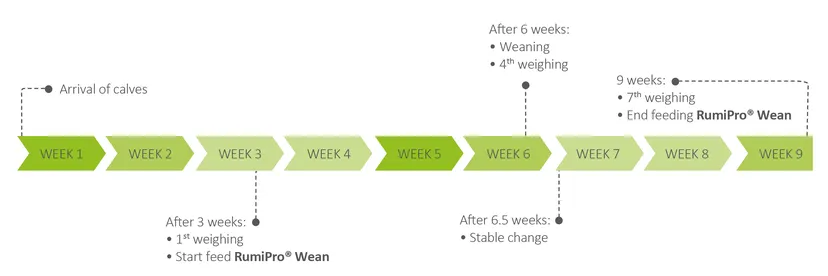 Figure 2: Trial timeline.
Both groups of calves had access to the same amount of milk provided by an automatic feeding system. However, on average, calves in the trial group consumed 1.3 kg less milk replacer (65 kg total) than calves in the control group (data not shown). Despite the lower milk replacer intake of the treatment group, the ADG for both groups was similar throughout the trial.
When weights are separated into pre-weaning and post weaning weights, however, clear differences between the groups emerge. Calves in the control group had higher ADG before weaning, whereas calves supplemented with RumiPro® Wean exhibited higher ADG after weaning (Figure 3).
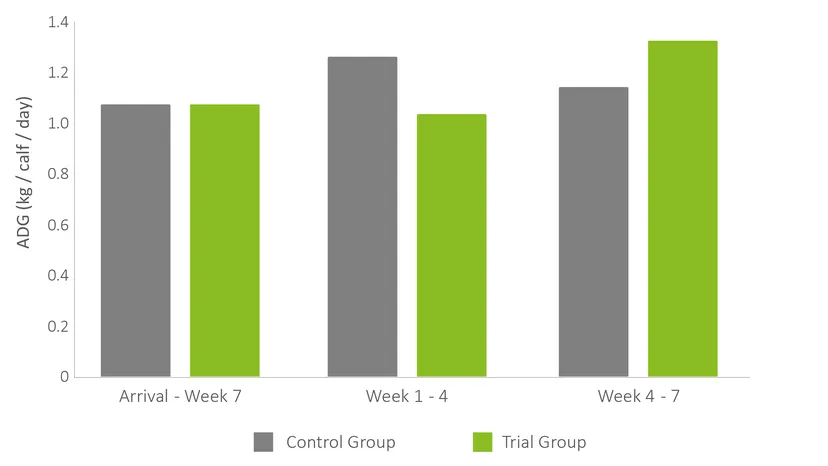 Figure 3: Supplementing RumiPro® Wean supported the maintenance of weight gains after weaning.
In practice, coat condition is often seen as an indicator of health. Deficiencies in the immune system or, as described above, possible rumen acidosis often manifest themselves in a shaggier and less shiny coat. Calves in the trial group experienced a brief decline in coat scores after weaning, but their scores improved within a week. In contrast, calves in the control group showed continuously worsening coat scores after weaning, with no recovery (data not shown).
Mycotoxin levels in the processed chopped calf straw and corn silage that were part of the feeding regimen were analyzed. The straw exhibited high concentrations of T-2 and HT-2 mycotoxins, while the corn silage exhibited moderately elevated levels of DON and ZEA. T-2/HT-2 and DON mycotoxins, for example, impair intestinal cell metabolism, resulting in increased intestinal permeability.
The results indicate that weaning had less of a negative impact on performance in calves fed RumiPro® Wean, as evidenced by more consistent and improved daily weight gain after weaning compared to the unsupplemented group. Moreover, supplemented calves had only a short-term deterioration of coat condition compared to the continuously worsening coat scores of the control group. It can also be assumed that all calves were challenged by the exposure to mycotoxins during the weaning period.
RumiPro® Wean provides targeted support for calves during the weaning process, helping the transition from milk to solid feed. The carefully selected combination of ingredients helps to promote rumen development, improve vitality, and reduce immunosuppressive factors, including exposure to mycotoxins.
Developed to provide support exactly where it is needed—in the first transit period of every calf: from monogastric to ruminant. Avoid after-weaning growth slumps with RumiPro® Wean.


