Smooth Transitions: Choline’s Secret to Dairy Success.
Dairy cows are remarkable animals, capable of producing up to 50 kg of energy-corrected milk (ECM) daily, just a few weeks after giving calving. This rapid increase in milk production requires significant changes in various body tissues to manage nutrient demands.
Challenges for Dairy Cows.
The transition period around calving is challenging for dairy cows due to substantial metabolic changes. Immediately after calving, cows experience a sharp rise in energy needs, while feed intake needs several weeks to increase from the low level around calving to its maximum. This creates a considerable energy deficit, prompting the body to mobilize fat for energy (Figure 1).
These circulating fatty acids are used primarily by the mammary gland and the liver. In the liver, fatty acids can be converted into energy, ketone bodies (like beta-hydroxybutyrate or BHB), or triglycerides. Unfortunately, the liver often cannot handle this excess fat efficiently, leading to triglyceride accumulation. This can result in conditions like fatty liver (hepatic lipidosis), ketosis, reduced performance, and increased risk of culling early in lactation.
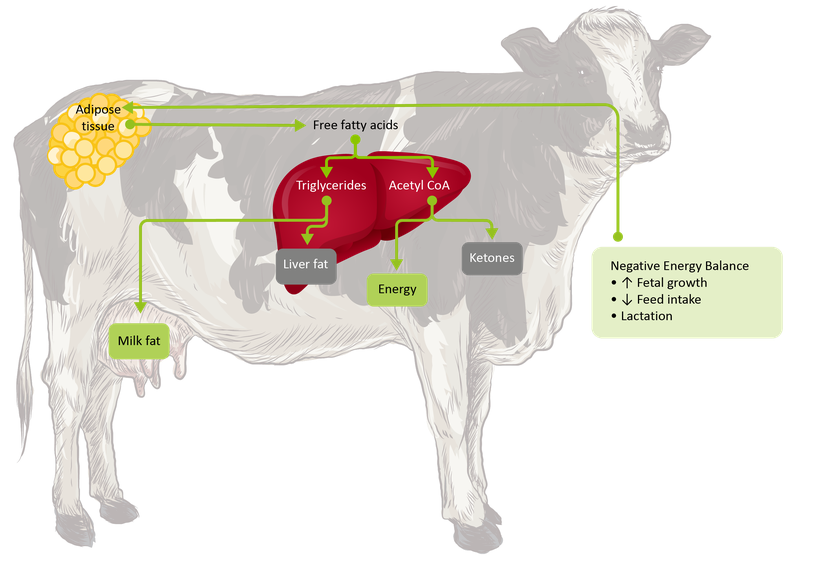 Figure 1: Schematic representation of metabolism during the transition period. Dairy cows experience a reduction in feed intake, especially during the last days of gestation along with increased needs of the fetus, fetal growth, and milk synthesis induces lipid mobilization. This results in increased concentrations of circulating fatty acids, which can be used for milk fat synthesis or can be taken up by the liver. In the liver, the fatty acids can be used for ATP energy, ketone body production, or re-esterification to triglycerides. The accumulation of triglycerides in the liver causes liver cell damage and hepatic lipidosis.
Why Choline Matters in Mammals.
Choline is a natural nutrient essential for many bodily functions. A critical role of choline is producing phosphatidylcholine, which is critical for fat transport and is an essential component of cell membranes. Choline is also involved in producing the neurotransmitter acetylcholine and S-adenosylmethionine (SAM), an important methyl-group donor necessary for many biological processes.
Choline Needs in Dairy Cows.
Unlike monogastric animals, ruminants cannot access the native choline in feed materials as it is rapidly broken down in the rumen. To a certain extent, though, cows can synthesize choline themselves. However, this synthesis consumes valuable methyl groups and generally meets only minimal choline requirements. Thus, during periods of high metabolic demand—such as transition into lactation and fetal development—choline becomes a limiting nutrient. To overcome this, cows must be supplemented with rumen-protected choline, which bypasses rumen degradation and is absorbed efficiently in the small intestine.
Benefits of Rumen-Protected Choline.
Rumen-protected choline products often use a lipid coating (typically fatty acids and triglycerides) to shield choline chloride from rumen microbes, ensuring effective absorption in the small intestine, with many benefits for both the cow and her offspring. Supplementing cows with rumen-protected choline has been shown to significantly reduce liver stress and lower the risk of severe ketosis.
Research highlights that rumen-protected choline can reduce liver triglyceride levels by up to 66% around calving, improving liver function and reducing the risk of fatty liver. Additionally, a 2020 meta-analysis involving 21 trials reported an average increase of 1.7 kg ECM per cow per day when supplemented during the transition period, emphasizing that diet composition—especially methionine levels—plays an important role in partitioning choline into the different pathways.
In case of low methionine in fresh cow diets, choline’s methyl donor function increases methionine availability via re-methylation. If milk production is supported by high dietary methionine, the role of choline is mainly liver health protection. Recent research also shows that supplementing pregnant cows with choline positively impacts calf development, improving colostrum quality, calf growth rates, immunity, and overall health.
RumiPro® Chol.
RumiPro® Chol is a highly effective, rumen-protected choline chloride supplement designed to improve choline availability in dairy cows during the critical transition period. Its effectiveness was demonstrated in a study involving healthy Holstein cows on two commercial dairy farms in Denmark.
Multiparous cows at each farm (350 on farm B; 600 on farm M) that calved between March and May were assigned to the treatment group (n=186). The treatment group was supplemented with RumiPro® Chol at 60 g/cow/day for 3 weeks before calving until 3 days after calving. The control group comprised 226 cows that calved outside of the March to May test period. Milk performance monitoring data including milk yield, % fat, % protein, calculated ECM, somatic cell count (SCC), BHB, and milk fatty acid composition were evaluated for the first 40 and 100 days of lactation.
Cows receiving RumiPro® Chol showed a significant increase in the average ECM production—2.97 kg/cow/d (d 5–d 40) and 1.17 kg/cow/d (d 5–d 100) post-calving compared to unsupplemented control cows (p < 0.05). Farm M had a generally low incidence of ketosis and observed a decrease from 3% to 2% in the treatment group.
There was also a noticeable reduction in milk BHB levels, indicating lower ketosis risk. In addition, supplementation with RumiPro® Chol increased milk protein and de novo milk fat synthesis, showing better overall energy metabolism (Table 1). This study shows that both, ketotic and non-ketotic transition cows benefit from supplementation with RumiPro® Chol.
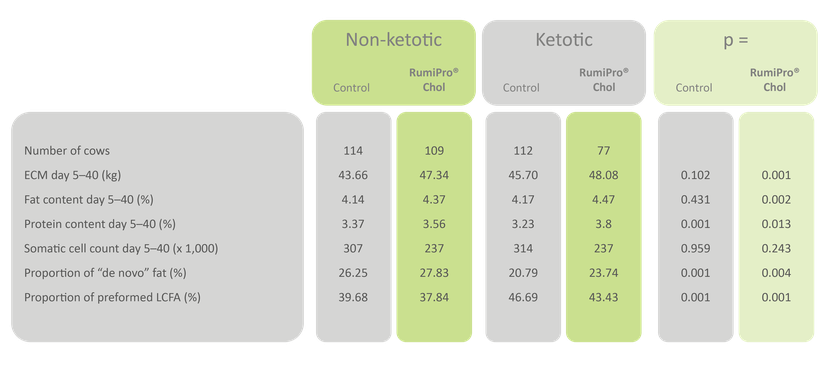 Table 1: Milk performance results < 40 days in milk depending on BHB-values (> 0,1 mmol/l milk = ketotic) and Choline supplementation (RumiPro® Chol). Fatty acids (FS) < C 16 = from “de novo“ fat synthesis and FS > C 16 = LCFA
Easy Integration with RumiPro® Chol.
RumiPro® Chol can be effortlessly incorporated into premixes, mash concentrates, or directly into total mixed rations, making it a practical and efficient solution for dairy herd management. By including RumiPro® Chol in your dairy nutrition program, you enhance herd health, reduce the incidence of metabolic diseases, and support a productive, healthy future generation.
Give your herd the best possible start into lactation with RumiPro® Chol.


