Managing Mycotoxins: Real Stories, Real Solutions.
The phone rings. On the line is a concerned pig farmer. His sow herd has been showing signs of “general instability” for several months now. He asks, “Can you help?” He explains further that the return-to-estrus rate has increased and suckling piglet vitality is noticeably low. Clearly, something is not right.
He had submitted his feed for analysis, which revealed the presence of the mycotoxin DON. The farmer had relied on an inexpensive zeolite product to protect his herd against mycotoxins, but it wasn’t enough. He needed a solution that could truly safeguard his herd and address his farm’s needs. After careful consideration, he replaced the zeolite product with B.I.O.Tox® Activ8 and began a six-month trial to compare the results with those of his previous product.
Silent Damage.
Mycotoxins are a large, diverse group of toxic substances produced naturally by fungi (molds). These harmful compounds easily contaminate a variety of raw materials, posing a significant threat throughout the feed and animal production value chain. Their presence can compromise animal welfare, severely reduce performance, and affect the industry’s sustainability and profitability.
Of the many known mycotoxins, those of primary concern to the industry due to their prevalence and adverse effects on livestock are aflatoxins, deoxynivalenol (DON), ochratoxin A, T-2 toxin (T-2/HT-2), fumonisins, zearalenone, and ergot alkaloids. These compounds can cause a wide range of adverse health effects, including affecting vital organs such as the liver and kidneys, disrupting the central nervous system, increasing gut permeability, and exerting unwanted estrogenic effects.
At the cellular level, mycotoxins cause damage through several key mechanisms. They can inhibit protein synthesis, alter gene expression, and damage cell membranes. These actions result in structural and functional changes to proteins, reducing overall cell performance. Additionally, all mycotoxins contribute to oxidative stress by damaging cell membranes.
Although cellular damage is not immediately visible, its cumulative effects manifest as disease and reduced organ function over time. Animals exposed to mycotoxins often exhibit subtle, unspecific signs. These signs can include decreased weight gain, reduced feed efficiency, decreased egg and milk production, and various reproductive disorders, making diagnosis difficult.
Stealthy Symptoms.
Exposure to DON during gestation and lactation leads to significant adverse effects on both sows and their offspring. For sows, DON exposure during lactation has been linked to mammary gland injury and disruptions in lactation-related hormonal balance due to inflammatory responses. During gestation, DON passes the placental barrier, leading to fetal exposure such that DON and its metabolites are detectable in fetal tissues.
In lactation, DON is transferred to piglets via colostrum and milk, resulting in direct exposure. Piglets exposed to DON both in utero and during suckling show impaired growth, feed refusal, and may suffer from immunosuppression. Early-life exposure to DON can lead to immunotoxic, neurotoxic, and reprotoxic effects.
Exposure to T-2/HT-2 mycotoxins during gestation and lactation significantly impacts the health of sows and the development of their offspring. Consumption of contaminated feed during gestation can decrease feed intake and weight gain in sows, as well as reduce feed conversion.
Piglets exposed to T-2/HT-2 in utero are at risk for developmental delays, immunosuppression, and higher infection rates due to immunosuppression. Piglets that suckle from exposed sows have reduced growth rates and weakened immune systems due to continued toxin exposure through the milk. Suckling exposure may also result in dermatitis, mucosal lesions, and altered digestive motility.
The typical time for sows to return to estrus after weaning under normal conditions is about 4 to 7 days, with around 85% of sows showing estrus within this timeframe. However, subclinical exposure to mycotoxins such as DON and T-2/HT-2 can disrupt hormonal balance and reproductive function, potentially extending the weaning-to-estrus interval and increasing the return-to-estrus rate. Moreover, T-2 toxin can cause infertility and miscarriage in sows and T-2/HT-2 are associated with teratogenic effects in reproductive cells, impairing conception rates and fetal development.
Trial Design.
This was a 12 month on-off trial in which 450 sows were supplemented with zeolite (12 kg/t feed) for six months (period I) before the product was replaced by B.I.O.Tox® Activ8 (1 kg/t feed) for another six months (period II). The sows were fed a home-mixed standard gestation or lactation feed consisting of wheat, barley, soybean meal, wheat bran, and soy hulls. Other than substituting B.I.O.Tox® Activ8 for the original zeolite, no changes were made during the trial.
At the beginning of the B.I.O.Tox® Activ8 testing period, final samples of the gestation and lactation feed were collected and analyzed for mycotoxins using LC-MS/MS. The results showed low-level contamination of DON and T-2/HT-2 toxins in both feed samples. The gestation feed contained 36 ppb of DON and 10.7 ppb of T-2/HT-2, whereas the lactation feed contained 48 ppb of DON and 7.2 ppb of T-2/HT-2. All other mycotoxins were below the detectable limit.
Results That Speak.
After using B.I.O.Tox® Activ8 for six months, the farmer reported improved overall herd stability and vitality of suckling pigs. Compared to the six months before using B.I.O.Tox® Activ8, the farmer noted a decreased suckling piglet mortality. Additionally, the farmer observed a reduced return-to-estrus rate after six months of B.I.O.Tox® Activ8 supplementation, resulting in an increased number of litters per sow per year. These performance improvements ultimately resulted in an increased number of weaned piglets per sow per year and improved profitability (Figure 1).
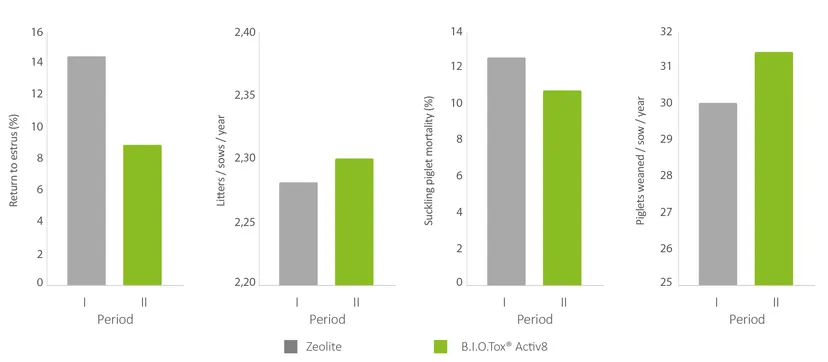 Figure 1: B.I.O.Tox® Activ8 supplementation improved sow fertility and decreased suckling piglet mortality, resulting in more piglets weaned per sow per year and increased litters per sow per year.
These results demonstrate the superiority of B.I.O.Tox® Activ8 over an inexpensive toxin binder product. They also show B.I.O.Tox® Activ8’s ability to reduce the adverse effects of low-level mycotoxin contamination on the reproductive performance of sows under field conditions.
Your Farm, Your Future.
Thanks to its supreme binding capabilities, B.I.O.Tox® Activ8 is highly effective against all major mycotoxins, including aflatoxins, ochratoxins, zearalenone, T-2/HT2-toxin, deoxynivalenol, and fumonisins. It is more than just a mycotoxin binder; it also contains natural detoxifiers that support the liver’s antioxidant and detoxification processes. B.I.O.Tox® Activ8 helps prevent or counteract mycotoxin-induced damage and improves overall performance.
B.I.O.Tox® Activ8 is a scientifically supported, reliable solution for mycotoxin contamination in animal feed. Its combination of superior binding capabilities and natural detoxifiers makes it an effective solution for improving animal health and performance and protecting human safety.
B.I.O.Tox® Activ8 is your solution for fast and efficient mycotoxin control!


