How Yeast Cell Walls Are Shaping the Future of Poultry Production.
The world’s population continues to grow and is expected to reach 9.6 billion by 2050. To meet the food needs of this growing population, inter alia poultry production has increased significantly. Global poultry meat production rose to almost 140 million tons in 2023, significantly exceeding pork production. This means poultry has become one of the largest and most important agricultural sectors, providing an important source of protein. The market for poultry meat is growing rapidly, with consumption projected to increase by 65%.
Advances Driving Poultry Productivity.
This impressive growth in the poultry industry has been driven by remarkable advances in nutrition, housing, management practices, and genetics. Poultry production has improved enormously in the last 30 years built on higher growth rates, better egg production, and improved feed conversion. Improvements inter alia focused on growth rate, feed efficiency, skeletal and organ health, and egg production and quality, thus modern laying hens can maintain production for up to 100 weeks and the fattening time of broilers has been reduced to roughly 35 days. Genetic selection programs now emphasize not only productivity but also bird health and welfare.
However, this increased productivity also means that poultry are now closer to their biological limits. As a result, factors such as nutrition, environment, and management have become even more critical. The removal of antibiotic growth promoters from feed has created new challenges in maintaining gut health and optimal bird performance.
The intestinal tract represents 70 % of a bird’s immune system, it produces and stores immune cells, supporting immunity by releasing cell-signaling proteins (cytokines) when activated. At hatch, chicks have an incomplete immune system, which develops at a few weeks of age. Thus, supporting immune defense is very important.
As such, gut health is now recognized as one of the most important challenges in the poultry industry, affecting nutrient digestion and absorption and ultimately overall performance. Issues such as maintaining gut health during diet changes, managing rising feed costs (doing more with less) and increased pressure from pathogens such as Salmonella and E. coli are ongoing concerns.
Mounting Pathogenic Pressure.
Antibiotic resistance in pathogenic bacteria has become a defining public health challenge of the 21st century, impacting human and animal health. A significant contributing factor is the role of livestock and food of animal origin, which have become reservoirs for resistant pathogens, enabling their transfer to humans. Among these, Salmonella and E. coli infections remain critical concerns worldwide.
Salmonella is recognized as a leading cause of foodborne illness worldwide and is the most critical foodborne pathogen within the EU. This pathogen causes millions of infections annually, resulting in a wide range of symptoms and significant economic burdens, estimated at billions of euros each year in the EU alone. The insidious nature of Salmonella’s transmission, often occurring without obvious signs in birds, underscores the urgent need for effective strategies to reduce its prevalence at the farm level to safeguard the food chain.
E. coli is one of the most commonly occurring and economically devastating bacterial infections of poultry worldwide, resulting in multimillion dollar losses annually, restricting the development of the poultry industry. Naturally found in the intestines of poultry, E. coli has also great capacity to cause serious infections and is responsible for high morbidity and mortality, with high levels of colonization. Whereas Salmonella infection mostly impacts on the human population as a foodborne illness, E. coli has greater effects on birds themselves causing devastating disease and losses.
Yeast Cell Walls: A Natural Defense.
Yeasts have been integral to animal nutrition due to their rich nutritional content and their ability to enhance gut health. In poultry nutrition, mainly inactive, prebiotic yeast products are used, often in the form of yeast cell wall products. The yeast cell wall, a complex structure providing shape and strength, contains various components such as β-glucans, mannan-oligosaccharides (MOS), proteins, lipids, and chitin.
Among these, β-glucans and MOS are the primary active components responsible for the yeast cell wall’s beneficial properties. MOS are located in the outer layer, while β-glucans are found in the inner layer. These two yeast cell wall components exert inter alia prebiotic effects, favoring healthy bacteria like lactobacilli and bifidobacteria.
The usage of yeast cell walls aims to reduce pathogens by high MOS levels & stimulate the immune system by an adequate proportion of β-Glucans. These two components of the yeast cell wall are able by their specific outer structure either to bind on gram-negative pathogens making them harmless or trigger immune cells for increased immune defending capacities.
Pathogen Reduction: Displacement of Pathogens by MOS.
Mannan oligosaccharides have been shown to reduce the incidence of gram-negative pathogens like Salmonella and E. coli by binding them, mitigating their adverse effects. Additionally, MOS supports a positive gut microbiota (eubiosis), which helps to get higher protection against harmful bacteria, reducing both the infection and transmission.
Adhesion to host tissues is a critical event in gram-negative pathogenesis, with type-1 fimbriae being one of the most common adhesive structures in this family. These fimbriae are important virulence factors. Bacteria with these fimbriae can adhere to receptors of the intestinal wall, which is the first step of bacterial infection.
Due to their specific structure, MOS are able to bind to the type-1-fimbriae of gram-negative bacteria like E. coli and Salmonella, preventing the adhesion of the pathogen to the intestinal wall and reducing its virulence (Figure 1). The complex of MOS and bacteria is then excreted in the feces. For a highly efficient binding, however, a large amount of small-particle-sized MOS is necessary.
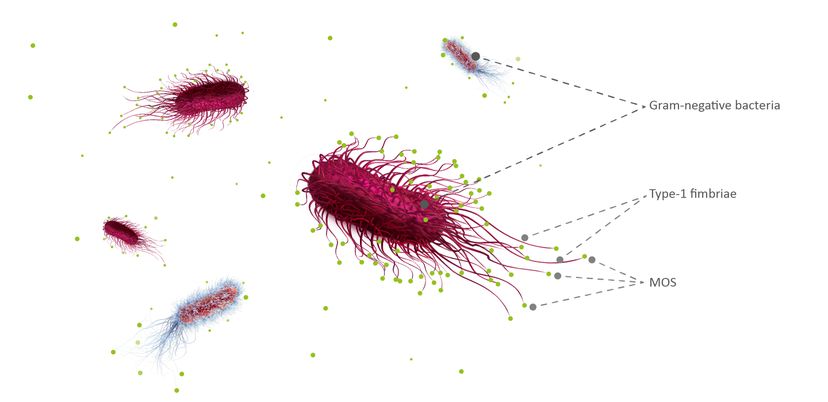 Figure 1: MOS can bind to the type-1 fimbriae of gram-negative bacteria, reducing adhesion to the intestine, inhibiting multiplication, and facilitating their removal (diagrammatic illustration).
Immune Stimulation: Boosting Birds’ Defenses.
Research shows that β-glucans from yeast cell walls can stimulate both innate, the first line of defense against pathogens, and acquired immunity. β-glucans are known activators of macrophages—a type of white blood cell that consumes and digests pathogens—and can also enhance acquired immunity by activating T-cells. Moreover, β-glucans can induce B cells to produce IgG immunoglobulin and stimulate cytokine production and release (Figure 2).
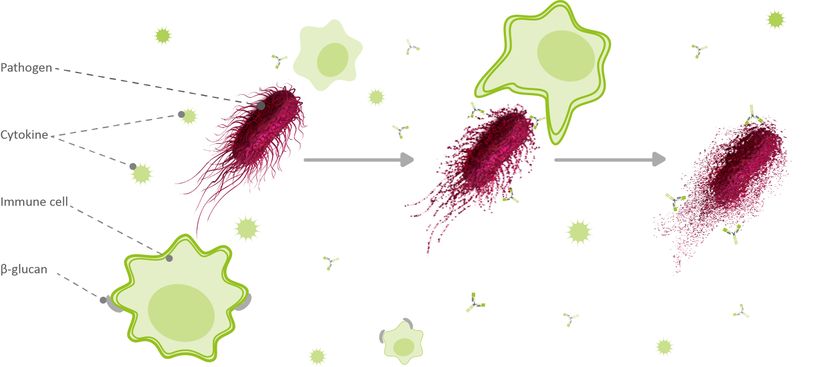 Figure 2: Immune system activation by β -1,3/1,6-glucans (diagrammatic illustration).
TechnoMos®: Elevating Quality and Thus Health
TechnoMos® is a premium yeast cell wall product, derived from a primary grown yeast, Saccharomyces cerevisiae, fermented under highly controlled conditions. This manufacturing process is focused on producing a unique product with a consistent quality. TechnoMos®’s quality is directly linked to the level of active ingredients like MOS and β-glucans.
TechnoMos® features a high content of MOS and the right amount of β-1,3/1,6-glucans with a particularly small particle size for optimal efficacy. This means TechnoMos® excels in its ability to bind gram-negative bacteria such as Salmonella and E. coli, while providing effective immune stimulation and favoring a healthy environment for the growth of positive microbiota (Figure 3). This results in improved production measures like increased daily weight gain and feed conversion rate (Figure 4).
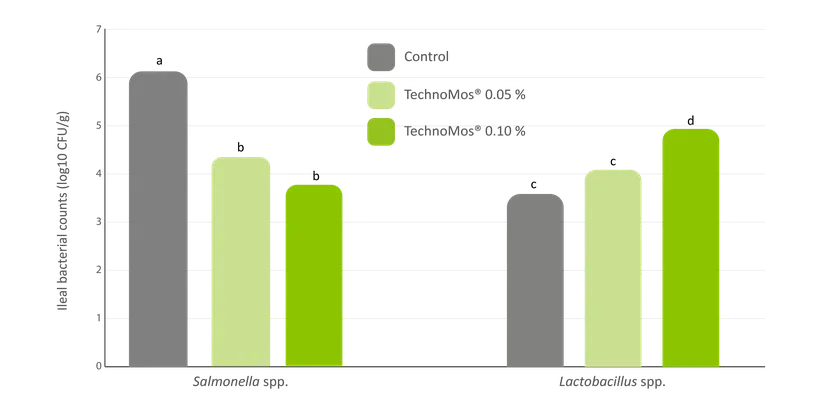 Figure 3: TechnoMos® supplementation at different dosages reduces ileal count of Salmonella spp. and increases beneficial ileal Lactobacillus spp. count in 70 days old laying hens under E. coli challenging conditions; different letters indicate significant differences ab P<0.05
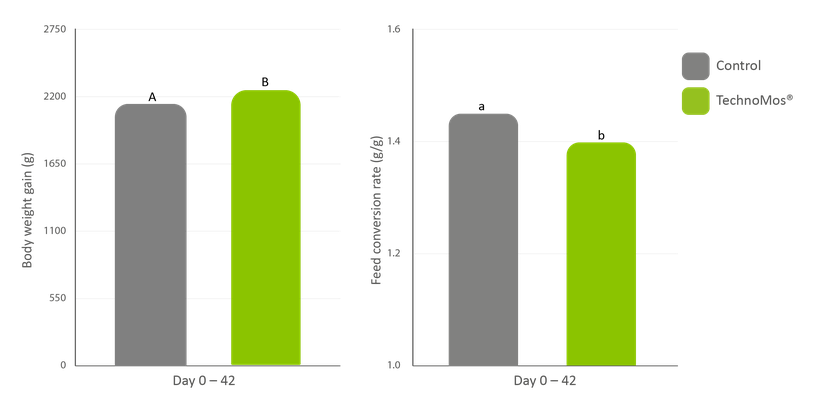 Figure 4: Body weight gain and feed conversion rate after 42 days of growth in broilers treated with TechnoMos® during starter (0.1%), grower (0.1%) and finisher (0.05%) phase compared to a non-treated control under a semi-challenged housing conditions (no cleaning, no disinfection, no coccidiostats); different letters indicate significant differences; ab P<0.05, AB P<0.1
Compared to by-product yeasts, TechnoMos® as a primary grown yeast exhibits excellent quality stability and a typical yeast odor and typical yeast flavor. Additionally, the low starch and adequate protein level in TechnoMos® can be seen as an indicator for a pure yeast cell wall product. In poultry flocks infected with Salmonella or E. coli, using TechnoMos® can contribute to a reduced shedding rate, thus minimizing the spread of these pathogens in the environment. TechnoMos® is part of a multifaceted approach that helps maintain a balanced gut microbiota, promoting overall health, disease resilience, and improved performance.


