Feed Intake First – The Top Priority.
Feed intake first - The top priority in weaning strategies!
The weaning process poses a major challenge for young piglets and requires careful management to minimize stress and support health to make this critical phase as comfortable as possible for the piglets, ensuring the best possible profitability. Tools such as functional, yeast-based feed materials can naturally aid piglets during this transition.
Weaning and its impact on young piglets
Weaning exposes piglets to major nutritional, environmental, social, and physiological stress. Piglets get separated from the sow, get moved to a new environment, and are confronted with high pathogen pressure and unfamiliar microbes. At the same time, their immune system is still immature, increasing their susceptibility to infections. These stress factors can disrupt gut health and functionality by causing microbial imbalance, inflammation, villous atrophy, and increased intestinal permeability, which often leads to post-weaning diarrhea, especially in the first week. In addition, piglets must adapt to unfamiliar solid feed while their digestive system is still developing. Consequently, weaning is one of the most challenging phases in a pig’s life, often resulting in reduced feed intake, health problems, and impaired growth.
The gastrointestinal tract plays a central role in the health of young piglets: it is responsible for feed digestion and nutrient absorption, regulates fluid balance, and supports enzyme and antibody secretion, while also serving as a critical barrier against pathogens. With around 70% of the immune system located in the gut, its condition largely determines how well a piglet can cope with the stress of weaning. Careful management - particularly the timing of weaning and the design of the right feeding strategy - is therefore essential to minimize weaning-related problems.
Boosting feed intake - The cornerstone of successful weaning
Separation from the sow is accompanied by a diet change. Piglets must adapt from the tasty and easily digestible sow’s milk to a solid feed that is less palatable and challenging to digest. This, of course, leads to a loss of appetite and reduced feed intake, which negatively affects intestinal morphology, digestion, and nutrient supply. Finally, reducing the piglets’ energy supply. Conversely, this condition does not increase appetite, of course - it's a vicious cycle.
To stabilize intake, feed should contain generally high-quality ingredients free from molds and oxidative damage, with balanced energy and nutrient density. The diet should provide the right proportion of amino acids, vitamins, minerals, fats, and fibers to meet piglets’ needs. Feed digestibility, which is closely linked to passage rate, is also a key factor influencing feed intake, along with the physical characteristics of the feed. Additive tools, such as palatable proteins (e.g., sweet milk proteins, porcine blood plasma), sweeteners, flavors, phytogenic additives or umami taste enhancers are also known to promote intake. Despite their proven benefits, effective tools like porcine blood plasma and pharmacological ZnO are facing declining acceptance or even regulatory restrictions. This has driven interest in natural alternatives, with yeast-based products showing promise in supporting feed intake, gut health, and immunity.
TechnoYeast uncovered – What’s in it and why it matters
TechnoYeast, derived from Kluyveromyces fragilis, is a functional feed ingredient that supports feed intake and promotes gut health, growth, and vitality in piglets, with effects comparable to or exceeding those of e.g., porcine blood plasma. Rich in functional, umami-tasting amino acids such as glutamic acid and aspartic acid, RNA-derived nucleotides, and digestible di- and tripeptides, it provides an effective combination for enhancing feed palatability, immunity, and gut health. Its yeast cell wall components, including mannan-oligosaccharides and β-glucans, contribute to gut health by reducing pathogens and stimulating the immune system.
Figures 1–3 illustrate the beneficial effects of TechnoYeast on weaned piglets fed at the recommended dosage for approximately 14 days. The figures summarize results from multiple trials assessing average feed intake, average daily gain, and average feed conversion ratio over a 42-day post-weaning period. Separate overviews are shown for trials in which porcine blood plasma was totally or partially replaced by TechnoYeast, and for trials comparing TechnoYeast with a commercial control diet without yeast. TechnoYeast showed equivalent performance to blood plasma, indicating its suitability as a replacement, and improved all parameters compared with the control diet, demonstrating positive effects on appetite, gut health, and overall functionality.
Exploring the taste-enhancing components
Glutamic acid and its salts (glutamates) are widely used as flavor enhancers in food and feed due to their functional and nutritional benefits. They primarily stimulate the umami taste, also known as “savory”. Aspartic acid also contributes to umami, but to a lesser extent. Piglets particularly like this taste because it signals high protein content, important for growth. In piglet nutrition, glutamic acid supports metabolism, immunity, protein synthesis, neurotransmission, and intestinal mucosa maintenance for gut balance.
5′‑Ribonucleotides, especially guanosine 5′‑monophosphate from yeast, can enhance umami taste. Although nucleotides alone have a mild flavor, they act synergistically with glutamic acid to amplify the umami signal at taste receptors, thereby increasing feed appeal. Beyond taste, nucleotides are important for tissues with high cell turnover, supporting gut function and immune defense in young animals.
However, feed palatability is not determined solely by the presence of single valuable amino acids or nucleotides. The structure of these proteins also affects taste, as di- and tripeptides - unlike free amino acids - are particularly known for providing an umami flavor. The product’s origin also plays a key role in flavor. By-products such as ethanol or brewer’s yeasts often negatively impact taste, with production residues producing sour or bitter notes. In contrast, primary yeast imparts pleasant yeast or cereal notes, while the unique Kluyveromyces fragilis delivers a distinct milky-umami flavor.
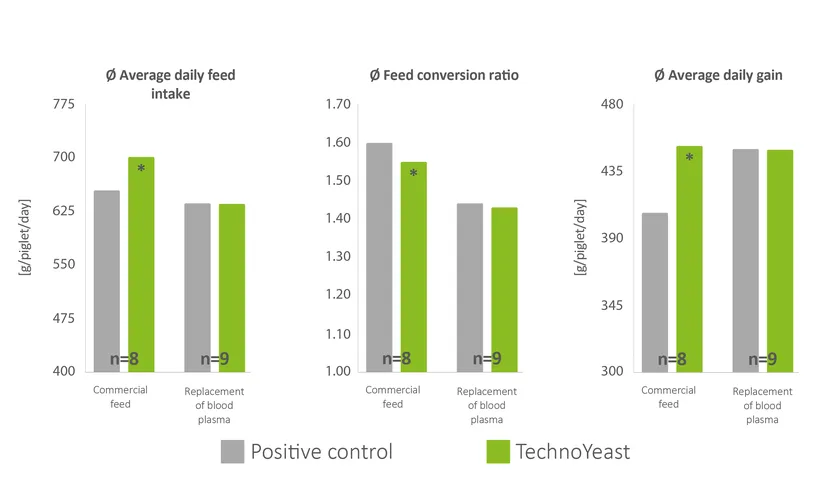 Figure 1-3: Effects of TechnoYeast at recommended dosage in prestarter (~14d) on performance in the total weaning phase (~42d) compared to a non-treated control or a fully/ partly blood plasma replacement [Meta analysis by Biochem Research; *significant (p<0.05) differences between the groups in the individual feeding trials]
In a nutshell
Weaning is the most critical and challenging period in a piglet’s life, posing multiple stressors that often result in reduced feed intake, impaired gut function, and slowed growth. Supporting feed intake during this stage is vital for maintaining both intestinal and overall health. TechnoYeast, a palatable functional feed ingredient derived from the yeast strain Kluyveromyces fragilis, has been shown to help support appetite and gut health in weaning piglets.


