Navigating the Future of Aquaculture
On November 15, 2022, the world quietly welcomed its 8 billionth person. With this milestone comes questions about how to feed the earth’s growing population without harming the environment and exhausting natural resources. One solution—aquaculture—is the fastest-growing food production sector. Aquaculture provides more than half of the fish consumed globally, supporting food security and employment for millions of people.
The Rising Tide of Aquaculture.
However, the aquaculture industry faces a major challenge. Fishmeal, a major component of many aquaculture diets, accounts for a large portion of aquaculture’s cost and environmental impact. Although the use of fishmeal and fish oil, which is made from wild-caught fish, is decreasing, there remains a danger that the need could outstrip the supply of small forage fish by 2037.1 Finding alternative sources of protein for aquafeed is crucial for the sustainability and profitability of this industry.
Turning Fish Vegetarian: The Plant-Based Revolution.
To address these issues—particularly farmed fish are increasingly becoming vegetarian. Plant-based feedstuffs are seen as a more sustainable and cost-effective alternative, but this dietary change poses new challenges, as many aquaculture species are not adapted to digest plant-based proteins, such as soybeans or corn.
However, because of anti-nutrients, plant-based feedstuffs can have lower nutritional quality and digestibility compared to fish meal. Some species, like tilapia or grass carp, are herbivorous and can, theoretically, consume 100% vegetarian feed, whereas Atlantic salmon, rainbow trout, and catfish, are carnivorous and have always been fed fish or animal protein as part of their diet.
Additionally, the feeding of plant-based feedstuffs to some species may cause growth and health problems. For example, soybean meal can cause enteritis in salmon, and protein concentrates from soybean and pea can trigger moderate changes in the intestine of salmon. High dietary wheat gluten is shown to have a negative impact on the feed intake and intestinal or liver health of salmon.
BetaTec® Aqua: A Game-Changer in Aquatic Feed.
BetaTec® Aqua is specifically tailored for modern feed formulations containing low fish meal and high vegetable protein content, supporting the health, growth, and performance of aquaculture. BetaTec® Aqua features several powerful components—all of which optimize plant-based diets and protect aquatic animals (Figure 1).
One of the key ingredients is betaine anhydrous, a feed attractant that enhances the taste of plant-based feeds, making them more palatable to farmed fish and shrimp. In addition to its flavor-enhancing properties, betaine anhydrous is a highly efficient methyl group donator. This property strengthens protein metabolism and immune defense mechanisms in aquatic animals and allows for a sparing of choline and methionine in the diet. Moreover, betaine anhydrous is an osmolyte, which means it can help reduce osmoregulatory stress during hot seasons.
Another essential component of BetaTec® Aqua is L-carnitine, which plays a crucial role in energy metabolism and fatty acid transportation. Plant-based diets often contain higher levels of carbohydrates, leading aquatic animals to accumulate fat. This can cause metabolic diseases like fatty liver. L-carnitine helps improve energy supply and reduce body fat content by supporting the efficient utilization of carbohydrates.
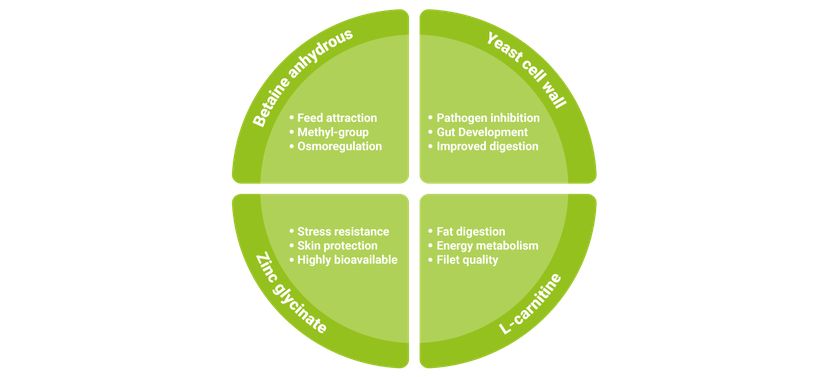 Figure 1.
BetaTec® Aqua contains yeast cell walls—a prebiotic. Yeast cell walls contain β-1,3-1,6-glucans and mannanoligosaccharides (MOS) that work to reduce the negative effects of stress and improve various physiological parameters. β-glucans are also well-known immune stimulants, increasing disease resistance and survival rates in farmed fish. β-glucan administration has been found to increase the expression of genes that are linked to mucus production. A thick mucus layer on the surface of the skin, as well as the intestinal epithelium, is necessary for a strong physical barrier against pathogens.
MOS have been widely used as feed additives, which have also known to be effective in aquatic animals. Dietary MOS promotes intestinal development, lowers feed conversion rates, and increases weight gain rates. In its role as a prebiotic, BetaTec® Aqua can also bind and remove pathogenic bacteria such as Vibrio spp.
Finally, organically bound zinc glycinate is included in BetaTec® Aqua to ensure the optimum health of aquatic animals. Physical stress during treatments, transportation, or increased stocking often leads to skin damage or lesions, which can reduce the fish or shrimp’s value. As zinc is critical for skin development, healing processes, and fighting infections and inflammation, it is important to maintain proper zinc levels. The organically bound zinc in BetaTec® Aqua is proven to be highly bioavailable. This makes BetaTec® Aqua an ideal choice for modern aquafeeds, which include many antagonistic substances like phytate (plant material) or tricalcium phosphate (fish meal from trimmings).
The Power of BetaTec® Aqua.
Nile tilapia (Oreochromis niloticus) is the second most farmed fish worldwide. In recent years, production has expanded because of its suitability for aquaculture. Although considered omnivorous, the FAO lists a typical diet for the Nile tilapia as one that contains 10–20 % fish meal in grower diets.2 Soybean meal and corn gluten meal have been used as a fish meal replacement in tilapia feeds, however, the complete replacement with these meals have resulted in decreased growth and feed utilization when compared to fish meal diets.
One trial explored the effects of supplementing BetaTec® Aqua on feed intake, growth performance, histomorphology, lipogenesis, and growth-regulating genes expression in Nile tilapia fed diets in which the fish meal was replaced with soybean meal (SBM) or corn gluten meal (CGM).3 Each diet treatment was tested three times in aquaria stocked with 10 healthy Nile tilapia each. Diets consisted of fish meal (control) and six test diets: soybean meal without fish meal, corn gluten meal without fish meal, soybean meal + 0.2 % (2 g/kg diet) BetaTec® Aqua, corn gluten meal + 0.2 % (2 g/kg diet) BetaTec® Aqua, soybean meal + corn gluten meal, and soybean meal + corn gluten meal + 0.2 % (2 g/kg diet) BetaTec® Aqua. Diets were formulated to be isonitrogenous and isolipidic.
Fish were fed until satiation twice daily for 56 days. All fish were weighed at a 10-day interval to determine growth and health and water quality was monitored twice weekly. At the end of the feeding trial, fish were harvested, individually weighed and euthanized.
Tilapia fed plant-based protein sources realized a significant decrease in growth performance as measured by final body weight, body weight gain, and average daily weight gain (p < 0.05). Additionally, feed intake and increased feed conversion ratio were poorer in these diets when compared to fish on the control fish meal diet (p < 0.05; Figure 2).
The inclusion of 0.2 % BetaTec® Aqua to diets containing plant-based protein significantly increased the growth performance as measured by final body weight, body weight gain, and average daily weight gain (p < 0.05). Feed intake and feed conversion ratio was also significantly improved when compared to the non-supplemented group (p < 0.05; Figure 2).
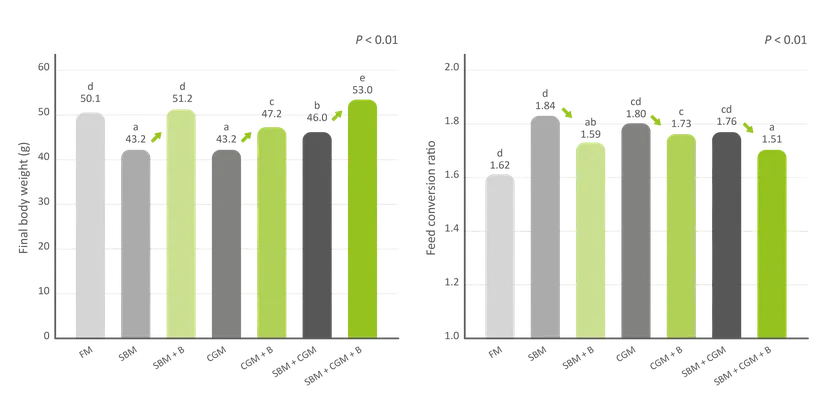 Figure 2: The addition of BetaTec® Aqua to plant-based protein diets allows for a full replacement of fish meal while improving performance; FM = fish meal; SBM = soybean meal; SBM + B = soybean meal + 0.2 % BetaTec® Aqua; CGM = corn gluten meal; CGM + B = corn gluten meal + 0.2% BetaTec® Aqua; SBM + CGM = soybean meal + corn gluten meal; SBM + CGM + B = soybean meal + corn gluten meal + 0.2 % BetaTec® Aqua. Columns with different letters are significantly different (p < 0.01); n=3.
Fish fed the soybean meal, corn gluten meal, or combination diets had significantly reduced intestinal villi lengths and numbers of goblet cells compared to fish fed the fish meal control diet (p < 0.05). The addition of 0.2 % BetaTec® Aqua to the soybean diet significantly increased villi height, muscular thickness, goblet cell number, and feed intake (all p < 0.05) demonstrating an overall improvement in intestinal health and function (Figure 3).
 Figure 3: Effect of dietary 0.2 % BetaTec® Aqua on intestinal villi length and goblet cell number; FM = fish meal; SBM = soybean meal; SBM + B = soybean meal + 0. 2% BetaTec® Aqua; CGM = corn gluten meal; CGM + B = corn gluten meal + 0.2 % BetaTec® Aqua; SBM + CGM = soybean meal + corn gluten meal; SBM + CGM + B = soybean meal + corn gluten meal + 0.2 % BetaTec® Aqua. Columns with different letters are significantly different (p < 0.05); n=4.
BetaTec® Aqua compensates for the challenges posed by the replacement of fish meal in fish diets and enhances the potential of plant-based protein diets. BetaTec® Aqua is a perfect feed additive for smaller feed mills and farmers that produce their own feed. The ingredients in BetaTec® Aqua improve feed intake and growth, reduce stress, and increase disease resistance.
BetaTec® Aqua—unlock a new era in sustainable aquaculture!
1 Froehlich HE, et al. Nat Sustain. 2018;1:298-303. doi:10.1038/s41893-018-0077-1
3 Ismail T, et al. Aquac Rep. 2020 Jul:1;17:100376.


