Biochem
Products
Biochem
gmp+

GMP+ (FSA)

Feed Safety

A Futter

A-Futter

Quality Management

EG OKO

EG-Öko

Organic Feed

QS Feed Safety

QS

Feed Safety

GMP+FRA

GMP+ (FRA)

Quality Management

ISO 50001

ISO 50001

Energy Management

ISO 9001

ISO 9001:2015

Quality Management

VLOG

VLOG

Quality Management

EvoVadis

EcoVadis

Sustainability

Let’s Connect:LinkedInFacebookYoutube

Links

  • About Us
  • Contact Us
  • Careers
  • FAQs
  • Articles
  • Press Releases
  • Environment and Safety
  • Whistleblower Platform

Products

  • All Products
  • TechnoSpore®
  • B.I.O.Tox® Activ8
  • E.C.O.Trace® Iron
  • BetaTrace® Iron
  • TechnoYeast
  • LiquiTonic LC

Animal Species

  • Ruminants
  • Poultry
  • Swine
  • Aquaculture
  • Companions

Legal

  • Imprint
  • Privacy Policy
  • Terms & Conditions

© 2025, Biochem Zusatzstoffe Handels- und Produktionsgesellschaft mbH

  • ImprintPrivacy PolicyTerms & Conditions
  1. Home
  2. News
  3. Articles
  4. The important way from calf to cow

The important way from calf to cow

Published on: January 27, 2021
Author: Biochem Team
Time: 5 min read
Share on:

The rearing of healthy calves and its influence on the performance potential of the later ruminant is generally acknowledged. And it is not only genetic which influences the performance!

Every day in cattle feeding, we deal with the rumen and the gut microbiota. After all, gut microbes of ruminants, mainly the rumen microbiota, provide 70 % of the daily energy requirement via the fermentation of poorly digestible fibers.[1]

But what is the role of the gut microbiota in calves? And how does this affect calf health and future performance?

Many studies investigating the intestinal microbiota in calves deal with pathogens causing diarrhea such as Escherichia coli. Not only pathogens but also other factors influence the gut microbiota in the rearing phase, such as age, feeding method, sampling site (intestinal wall/intestinal contents), intestinal region and additives. In general, the younger a calf, the more the microbiota composition can still change. Therefore, the supplementation of probiotics and prebiotics is often recommended in young animal nutrition to support the development of a healthy microbiota.[2]

For the development of the rumen microbiota the weaning phase seems to be a critical phase. The rumen microbiota must develop next to the size of the rumen and its epithelium. Significant differences in the rumen microbiota can be seen in the first few months of life. Not only that, there are also differences between the rumen wall-associated and fluid-associated communities.[3] Further research aims to understand the activity of the rumen microbiota and to support the rumen development and function during critical transition periods.[2]

What is the role of the gut microbiota on calf health?

The intestinal epithelium can be a portal of entry for pathogenic agents. With the help of an early developed microbiota, the intestinal mucosal epithelium develops and regulates the intestinal immune system. Thus, the microbiota plays a key role in defense against pathogens. In addition, there is a strong relationship between intestinal microbial profile, growth and health of animals.[4] On the one hand, this can be explained by different metabolites: butyrate, for example, has a very high energy value and is used by rumen- and intestinal epithelia as an energy source. On the other hand, some metabolites of certain microorganisms have anti-inflammatory effects.[4] Stress—for example caused by castration—also influences the gastrointestinal microbiota of calves.[5] Microbial diversity, especially in lightweight calves, is reduced by stress [5], putting them at risk for dysbiosis (imbalance of the gut microbial community). Stress also occurs at weaning, which can be countered with good quality feed, appropriate age at weaning, and good management.

Often underestimated: the importance of the intestinal microbiota in calves.

There is evidence that productivity and feeding efficiency are also related to the intestinal microbiota.[6]

Which pro- and prebiotics can I use to support the calf’s rumen and gut microbiota?

Good feeding and hygiene management is of course the first requirement for a healthy start of the calves. Since infection pressure can be high regardless optimal conditions, we recommend the strategic use of probiotics and prebiotics.

The target is to use pro- and prebiotics to improve calf health and performance, and to promote digestion and prevent pathogen colonization through a balanced microbiota—in the gut and rumen. Their use is also recommended in stressful situations.

For example, the following pro- and prebiotics can be used:
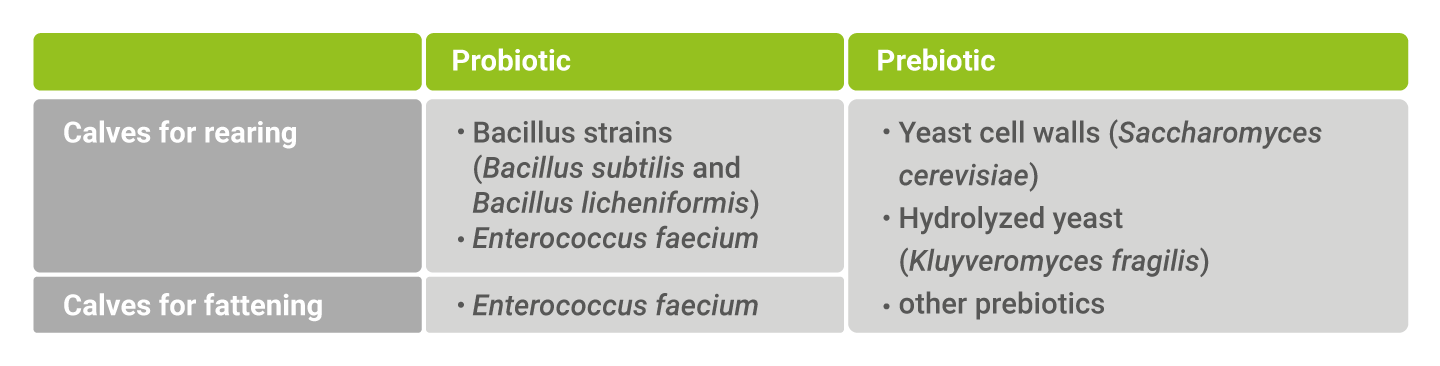
use of probiotic and prebiotic in calves for rearing and fatteningHere is an example of the use of hydrolyzed yeast in calves:

Stressful situations often occur due to regrouping or transport of the animals, that are accompanied by diarrhea or other diseases such as respiratory problems.[7] Ingredients of hydrolyzed yeasts have an immunomodulatory effect that strengthens the calf in such stressful situations and can prevent diseases. TechnoYeast (hydrolyzed yeast; Kluyveromyces fragilis)) already proved this, as we can see in the study performed by Hoping et al. in 2020.[8]

In this study, 209 male Simmental calves were used, which were on average 41.3 days old, weighed 81.7 kg, and were transported from different farms to the experimental farm. After being randomized into two feeding groups, (control: 107 calves; TechnoYeast-group: 102 calves) the trial-group received 10 g TechnoYeast per calf per day for 35 days applicated via the milk replacer. Furthermore, 5 kg soy meal/ ton concentrate were exchanged by TechnoYeast within the first 59 days. In addition to weight gain, daily feed presentation was determined, and feces and animal health were assessed.

Figure 1: Effect of TechnoYeast supplementation on calf body weight gainFigure 1: Effect of TechnoYeast supplementation on calf body weight gain. Data with different superscripts are significantly different (P <0.05).

The TechnoYeast-group achieved a higher final weight and was able to achieve a higher sales revenue of €9.30 per animal. When looking at feed conversion (3.10 kg dry matter/kg live weight gain in the control group vs. 2.88 kg dry matter/kg live weight gain), the supplemented group did not only obviously show better daily weight gain but also utilized nutrients more efficiently.

When looking at fecal consistency, it was noticeable that diarrhea with more severe symptoms occurred more frequently in the control group than in the TechnoYeast supplemented group (control 18.8% of diarrhea was liquid to watery vs. 13.2% in the TechnoYeast-group).

Figure 2: Number of individual animal treatmentsFigure 2: Number of individual animal treatments (stand. per 100 calves) in the control and TechnoYeast-groups.

Worthwhile to take a look: the use of medication during the study. The treatment frequency of the calves was lower in the supplemented group and decreased in both gastrointestinal and respiratory diseases. So, hydrolyzed yeast has been shown to have a positive impact on animal health! Consequently, this also has reduced the costs of individual treatments (€3.81 individual animal treatment costs in the control group vs. €2.34 individual animal treatment costs in the TechnoYeast-group).

The use of hydrolyzed yeast in calves positively affects their performance and health!

Indicated by…

  • higher daily weight gains

  • better feed conversion

  • improved feces consistency

  • reduction of single animal treatments

Therefore, we recommend the strategic use of pro- and prebiotics, as the microbial diversity and functionality of the rumen and intestine will be promoted. With individual solutions depending on the farm conditions, the health of the calves and their performance will be strengthened!

More Articles

Feed Intake First – The Top Priority.

Feed Intake First – The Top Priority.

The weaning transition is a critical window for piglet development. When feed intake drops, gut integrity follows, creating a cycle of poor performance. Our latest research explores how the umami-rich profile of Kluyveromyces fragilis provides a stable, natural foundation to maintain appetite and support immunity during this high-stress period.

Share on:
Securing the Future of Dairy Performance with Rumen Bypass Betaine.

BetaTrace®: Securing the Future of Dairy Performance with Rumen Bypass Betaine.

Standard betaine is often lost to rumen degradation, limiting its ability to support transition cows when they need it most. BetaTrace® overcomes this challenge by complexing betaine with organic trace minerals, allowing it to bypass the rumen and effectively support liver health and metabolism. Discover how this dual-action additive increases methionine availability and boosts lactation performance while delivering essential minerals.

Share on:
Managing Mycotoxins: Real Stories, Real Solutions.

Managing Mycotoxins: Real Stories, Real Solutions.

When a pig farmer faced unexplained herd instability in his sows, standard zeolite binders failed to provide a solution. Read how switching to B.I.O.Tox® Activ8 restored reproductive performance and improved weaned piglet numbers in a decisive six-month field trial.

Share on:
Time to Rethink Weaning: Why Smarter Strategies Deliver Stronger Biological and Economic Outcomes in Dairy Calves.

Time to Rethink Weaning: Why Smarter Strategies Deliver Stronger Biological and Economic Outcomes in Dairy Calves.

Viewing heifer rearing merely as a cost center overlooks its potential as a massive investment in your herd's future productivity. The weaning phase is particularly critical; mistakes here can undo early gains and permanently reduce lifetime milk yields. Discover how to smoothen weaning and protect your investment with RumiPro® Wean.

Share on:
Day-Old Chick Quality: Why is it an important topic?

Day-Old Chick Quality: Why is it an important topic?

Discover why the quality of day-old chicks has become the make-or-break factor in today's volatile poultry market. Learn how the first hours after hatching can determine the performance potential of your entire flock, and why leading producers are implementing specialized early support protocols. Unlock science-backed strategies that can dramatically improve your day-old chick (DOC) quality and profitability.

Share on:
Managing Large Litters

Managing Large Litters.

Breeding progress has delivered bigger litters—but not without costs. Sow breeding goals have changed over the past few decades with a focus on selecting higher ovulation rates and large litter sizes. Not only does this place increased demand and pressure on sows, but large litters increase birth weight variabilityt, competition at the udder, and pre-weaning losses. This newsletter explains practical, science-based ways to support sow health, colostrum and milk supply, and early piglet care. You’ll also see how water-based delivery and farm-individual feeding concepts can boost uniformity and weaning success.

Share on:
TechnoSpore® in Broilers: A Meta-Analysis.

TechnoSpore® in Broilers: A Meta-Analysis.

Modern broiler production faces unique challenges due to rapid growth and high disease susceptibility. Discover how TechnoSpore®, a probiotic based on Bacillus coagulans DSM 32016, enhances production efficiency by improving gut health and feed digestibility. Backed by extensive studies involving over 3 million birds, TechnoSpore® delivers measurable results that can significantly improve your flock's performance.

Share on:
Mycotoxins: A Pervasive Challenge.

Mycotoxins: A Pervasive Challenge.

Mycotoxins pose a silent, yet pervasive threat to animal feed and livestock health worldwide. Discover how these hidden dangers develop, why multi-contamination is a growing concern, and the advanced methods crucial for accurate detection. Learn how Biochem faces these challenges. Discover what is possible with mycotoxin analysis including tailored strategies to protect animal welfare and profitability.

Share on:
Rethinking Trace Minerals: Healthier Shrimp, Cleaner Planet with E.C.O.Trace®.

Rethinking Trace Minerals: Healthier Shrimp, Cleaner Planet with E.C.O.Trace®.

Trace minerals are vital for your animals’ peak performance, but how can we ensure their optimal intake without harming our planet? Traditional supplementation can lead to significant mineral waste and environmental concerns. Discover how E.C.O.Trace® organic trace minerals offer a smarter solution, enhancing absorption to deliver better shrimp health with less environmental impact. It’s time to achieve more with less for a sustainable future in shrimp nutrition.

Share on:
Smooth Transitions: Choline’s Secret to Dairy Success

Smooth Transitions: Choline’s Secret to Dairy Success.

Did you know that supporting your dairy cows with choline can significantly improve milk production and herd health during the critical transition period? Discover how RumiPro® Chol helps cows efficiently manage nutrient shifts, reducing the risk of fatty liver and enhancing overall performance—benefiting both cows and their calves. Learn more about how choline can optimize your herd’s success!

Share on:
How Yeast Cell Walls Are Shaping the Future of Poultry Production

How Yeast Cell Walls Are Shaping the Future of Poultry Production.

Poultry production is soaring to meet the protein needs of a rapidly expanding global population. With antibiotic restrictions and pathogen pressure pushing birds to their limits, gut health is now mission-critical for success. Discover how yeast cell walls like TechnoMos® are transforming poultry performance, supporting disease resistance, and boosting productivity.

Share on:
Navigating Weaning Challenges: Optimizing Piglet Health and Performance

Navigating Weaning Challenges: Optimizing Piglet Health and Performance.

Weaning can be a make-or-break moment for piglet health and performance. Learn what “gut health” looks like and how the process of weaning affects piglets. Discover how targeted nutritional strategies, including prebiotics, probiotics, and more, can minimize stress, support gut health, and pave the way for a smooth transition and optimal growth.

Share on:

Subscribe to our Newsletter.

Stay in the loop! Get educational insights and product news delivered right to your inbox. Sign up for our quarterly newsletter today!