EU Mycotoxin Guidance Values Tighten: How Feed Manufacturers Can Prepare for 2027
The European Commission has introduced stricter, species-specific guidance values for deoxynivalenol (DON), zearalenone (ZEA), ochratoxin A (OTA), T-2/HT-2 toxins, and fumonisins (FUM) in raw materials and final feed. Published as Commission Recommendation (EU) 2026/1801, the updated guidance replaces the previous Recommendations 2006/576/EC and 2013/165/EU. It will apply from 1 July 2027, while selected raw materials, specifically maize, sorghum, soybean, sunflower, and their derived products, will remain subject to a transition period until 1 October 2027.
Key Takeaways
The revised and lowered guidance values will apply from 1 July 2027, although selected raw materials will have a transition period until 1 October 2027.
The recommended limits now vary more precisely according to the mycotoxin, animal species, and production stage.
Testing for several mycotoxins shall be carried out to get a more complete picture of co-contamination.
Feed businesses should prepare early by updating HACCP systems, strengthening supplier communication, and combining precise diagnostics with targeted toxin-binder selection.
What changes under Commission Recommendation (EU) 2026/1801?
The updated recommendation reflects new scientific assessments by the European Food Safety Authority (EFSA), updated mycotoxin occurrence data across Europe, and a growing understanding of chronic, subclinical effects, including impaired gut barrier function, reduced feed intake, lower daily weight gain, and weaker animal performance. The guidance values therefore provide important benchmarks for risk management, but they do not replace representative sampling or the assessment of contamination involving multiple toxins.
Key guidance values for complete feed
Because susceptibility varies by species and production stage, the recommendation sets different guidance values for different animal categories. These lower values make it highly recommended for the feed business to carefully monitor mycotoxins in feed to avoid adverse animal health effects.
Mycotoxin | Examples of revised guidance values |
|---|---|
Deoxynivalenol (DON) | 0.7 ppm for pigs, 0.5 ppm for aquatic animals, and 1 ppm for broilers. |
Zearalenone (ZEA) | 0.1 ppm for piglets, gilts, puppies, and kittens. |
T-2/HT-2 toxins | 0.1 ppm for chickens for fattening and 0.05 ppm for sheep. |
Fumonisins B1 + B2 | 1.0 ppm for pigs and horses; 2 ppm for laying hens and broilers. |
Ochratoxin A (OTA) | 0.01 ppm for pigs, cats, dogs, and rabbits. |
Source: Commission Recommendation (EU) 2026/1801, available at https://eur-lex.europa.eu/eli/reco/2026/1801/oj/eng
What should feed businesses do now?
Feed mills, raw-material suppliers, and livestock producers should start preparing well before the implementation dates. Raw materials and final feeds that exceed the new guidance values shall only be placed on the market or used if explicit precautionary measures are in place to safeguard animal health. Thus, acting early can reduce the risk of rejected loads, formulation disruptions, and avoidable performance losses.
Update HACCP systems
These revised guidance values should be actively integrated into the hazard analysis and critical control points (HACCP) systems and used, where appropriate, to define critical limits at relevant Critical Control Points. This creates a clearer basis for preventing, eliminating, or reducing mycotoxin hazards to acceptable levels.
Test for multiple mycotoxins simultaneously
To identify co-occurring contamination, the European Commission recommends that feed businesses should analyze DON, ZEA, OTA, T-2/HT-2 toxins, and FUM within the same analytical program. The recommendation also encourages the annual submission of anonymized testing data to EFSA by 30 June.
Strengthen supplier communication
Whenever raw materials exceed the relevant guidance values, suppliers should communicate the findings clearly to feed manufacturers/customers. This information enables safer formulation decisions and helps determine which precautionary measures are needed before the material is marketed or used.
Why is regulatory compliance alone not enough?
Mycotoxins can affect animals without causing obvious clinical symptoms, because their damaging effects occur at the cellular level. The actual risk depends on more than the measured concentration alone. Species, age, production stage, metabolic rate, performance level, and additional environmental stressors, such as heat, poor ventilation, overcrowding, and subclinical infections, all influence susceptibility. Young animals and high-performance livestock can therefore be particularly vulnerable.
When several mycotoxins occur together, their combined effects may act synergistically and impair gut integrity, immunity, feed conversion, and daily gain, even if each individual toxin remains below its respective guidance value. While the new EU guidance values provide excellent orientation, keeping rations even below them is strongly recommended.
How can a data-driven approach improve mycotoxin management?
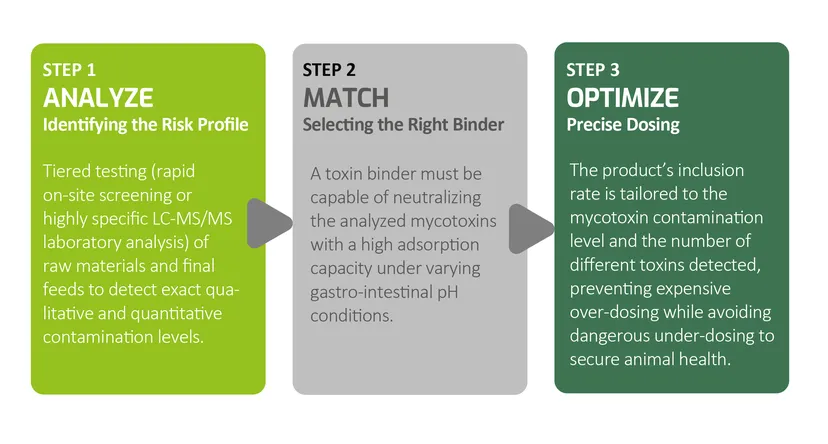
To successfully implement the new regulatory recommendations while also addressing the biological challenges involved in ensuring animal health and welfare, a smarter, data-driven mycotoxin management is required. Biochem addresses this challenge with a three-step approach that connects reliable diagnostics to targeted toxin-binder selection and precise dosing.
Turn tighter guidance into a feed-safety advantage
The transition to Commission Recommendation (EU) 2026/1801 presents a challenge, but it also creates an opportunity to strengthen feed safety and protect profitability. By combining better diagnostics, clear supplier communication, updated HACCP procedures, and targeted mitigation strategies, feed businesses can respond to tighter safety margins with greater confidence.
Biochem supports this approach with MycService for fast, reliable mycotoxin diagnostics and the B.I.O.Tox® range of mycotoxin binders for efficient, irreversible adsorption of the specific mycotoxins. Together, these solutions help feed manufacturers and livestock producers make informed decisions that support animal health, performance, feed safety, and sustainable profitability. Given tighter safety margins, proactive prevention remains the key to performance.
References
Commission Recommendation (EU) 2026/1801, available via EUR-Lex: https://eur-lex.europa.eu/eli/reco/2026/1801/oj/eng


