How organically bound trace minerals improve claw health in dairy cows and sows
Claw health is complex. Herd management, housing, genetics, and feeding must be perfect. But have you also thought about the different trace mineral sources? They can make a difference.
Claw health is a highly relevant issue—both in dairy cow and sow herds. Poor claw health (Figures 1 and 2) is a challenge for farmers and veterinarians, because it often goes along with lameness and is one of the most frequent causes for culling. What is the background to this? And what role does trace mineral supply play in the field of claw health?
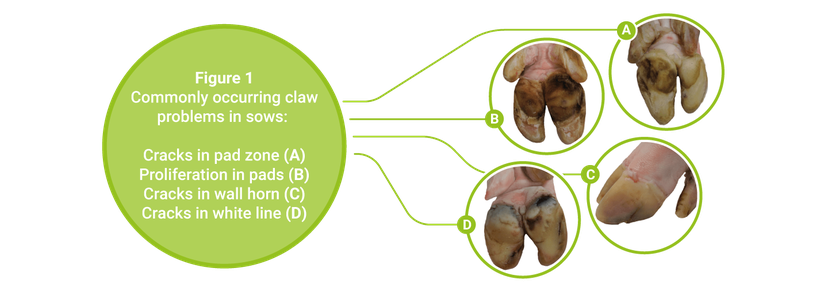 Figure 1: Commonly occurring claw problems in sows: cracks in pad zone (A), proliferation in pads (B), cracks in wall horn (C), cracks in white line (D).
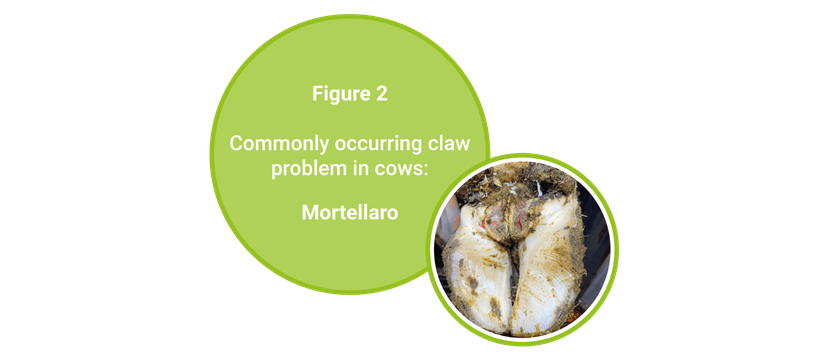 Figure 2:Commonly occurring claw problem in cows: mortellaro.
Claw problems depress animal well-being and economic benefit.
Poor claw health has a negative influence on animal welfare. Pain and lameness due to claw problems impair animal well-being and hinder normal behavior of both, dairy cows and sows. Affected animals spend more time resting and less time standing. This leads to a reduced feed and water intake and a deteriorating body condition. Moreover, the stress induced by claw problems can impair the immune defense which makes the animals more susceptible to other diseases, too.
But not only animal welfare, also the economic benefit of the farm is greatly affected by claw health. Premature culling, especially of high-performing young sows and cows that cannot return their investment, means high economic losses for the farmer. Claw problems can also bring high veterinary costs, potentially combined with discarded milk in cows, and impair fertility of cows and sows. Piglet production in sows is also harmed, shown by higher numbers of crushed piglets, lower numbers of weaned piglets and reduced weaning weights. Dairy farmers will experience reduced milk yield when the cow is lame, also lowering the economic benefit.
Role of trace minerals in claw health.
What factors have an influence on claw health? Claw health of dairy cows and sows is multifactorial, so there are several aspects to consider in order to ensure a good claw status of the herd. Besides housing, genetics, and management (e.g., regular claw trimming), also the feed formulation is known to have a relevant effect on claw health. Within the feed formulation, one puzzle piece for good claw health is a proper trace mineral supply. Even though fed in very small quantities related to total feed, trace minerals fulfil essential functions in claw health that cannot be compensated by other dietary components (Figure 3).
Zinc (Zn): The claw horn is composed of keratin proteins and the so-called intercellular cementing substance (ICS) which consists of lipids and glycoproteins. Zn is essential for the keratin synthesis as it is among others, part of many enzymes needed in this process. As part of the enzyme superoxide dismutase, Zn, but also Cu and Mn are involved in the antioxidant system and prevent the lipids in the ICS from oxidative damage. This ensures strength and elasticity of the claw horn. Moreover, Zn is important for wound healing processes which minimizes the risk for the entrance of bacteria and wound infections.
Copper (Cu): Cu is necessary for the formation of connecting disulfide bridges between keratin filaments during horn formation as part of the enzyme thiol oxidase. Also, the biogenesis of connective tissues is depending on Cu, as it is needed for the cross-linkages between collagen and elastin fibers via the enzyme lysyl oxidase. This taken together, Cu is vital for the strength and elasticity of claw horn and connective tissues.
Manganese (Mn): Mn is essential for the strength of bones and connective tissues as it is part of many enzyme systems that are involved in their formation and growth. Moreover, a strong development of bones and connective tissues contributes to a correct leg conformation and claw position. Thus, the claws are loaded in a balanced way reducing the chance of developing claw problems.
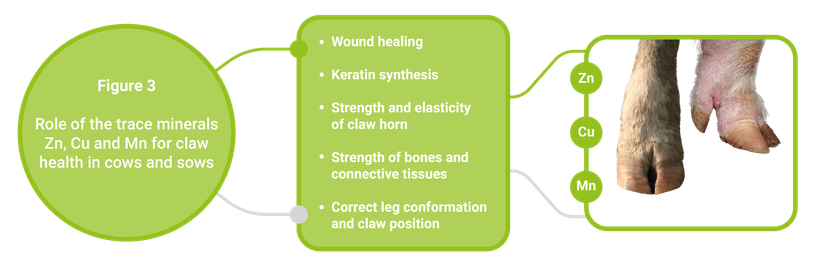 Figure 3: Role of the trace minerals Zn, Cu and Mn for claw health in cows and sows.
Advantages of organically bound trace minerals.
Trace minerals can only provide a nutritional value to the animals when they were absorbed across the intestinal wall. Therefore, a proper amount of trace minerals in the feed alone is not sufficient, but also the trace mineral source greatly matters. A lot of studies show that the bioavailability of organically bound trace minerals is higher than that of inorganic sources like sulfates. Sulfates are susceptible to antagonistic effects as they easily dissociate in the upper gastrointestinal tract. The released free metal ions can form insoluble complexes with other dietary components or compete for transport mechanisms at the intestinal wall. As a result, a high amount of unabsorbed trace minerals is excreted via the feces. In contrast, organically bound trace minerals are typically chelates where the trace mineral is bound to single amino acids like glycine or to a mix of amino acids from hydrolyzed soy protein. Due to their higher binding strength, chelates are more stable and less susceptible to antagonistic effects. Thus, a higher amount of trace minerals can be absorbed.
Improved claw health in cows and sows.
As shown in several field trials by Biochem, the use of glycine chelates (E.C.O.Trace®) is beneficial for claw health and performance of cows and sows. In a recent field trial on a dairy farm with 800 cows in Eastern Germany, the control group received mineral feed providing 1,200 mg Zn, 800 mg Mn and 240 mg Cu per cow and day from inorganic sources. In the trial group, between 30 and 50 % of the inorganic forms were replaced by glycine chelates. The use of glycine chelates could reduce the incidence of mortellaro and sole ulcer diagnoses and simultaneously, improve fertility parameters and milk yield (Figure 4).
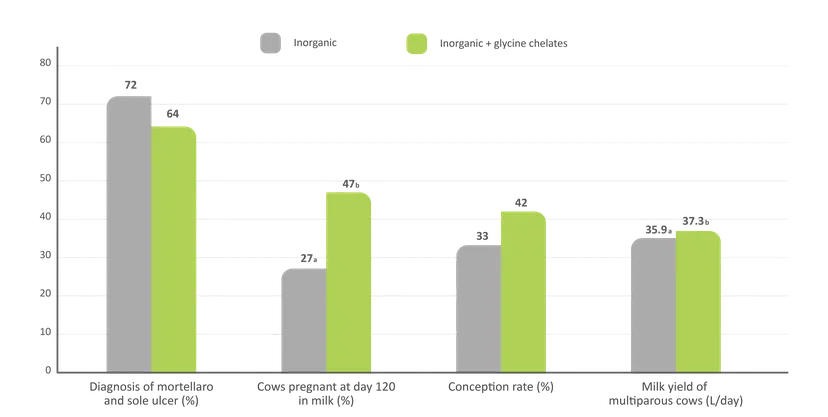 Figure 4: Improved claw health and performance in dairy cows by partial exchange of inorganic Zn, Cu and Mn with glycine chelates (E.C.O.Trace®) (Means, ab significant differences between treatments, p < 0.05) (Mählmeyer & Landwehr, 2019).
In order to reduce the incidence of claw problems on a farm with 750 sows in Northern Germany, the animals were fed a combination of glycine chelates (E.C.O.Trace®) (50/30/10 ppm Zn/Mn/Cu) and inorganic trace minerals for 12 months during the whole gestation and lactation period. The change in trace mineral feeding led to an improvement of several common claw problems in sows (Figure 5). This went along with a reduced replacement rate and a higher longevity of sows (Figure 6).
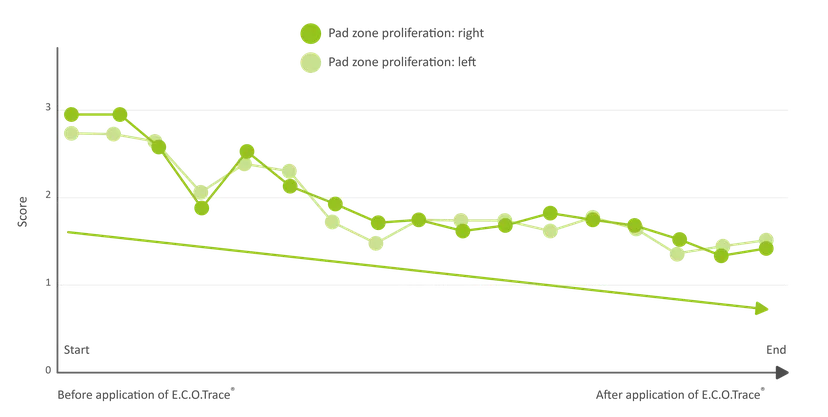
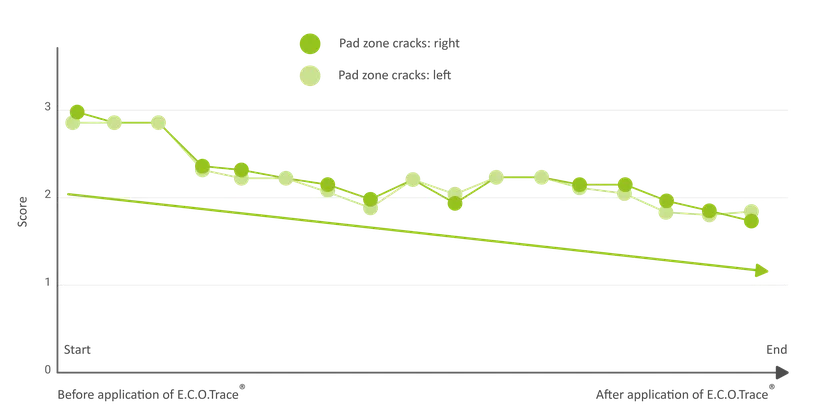 Figure 5: Positive effects of glycine chelates (E.C.O.Trace®) on claw health of sows (1 = symptom did not occur; 4 = strong occurrence of the symptom).
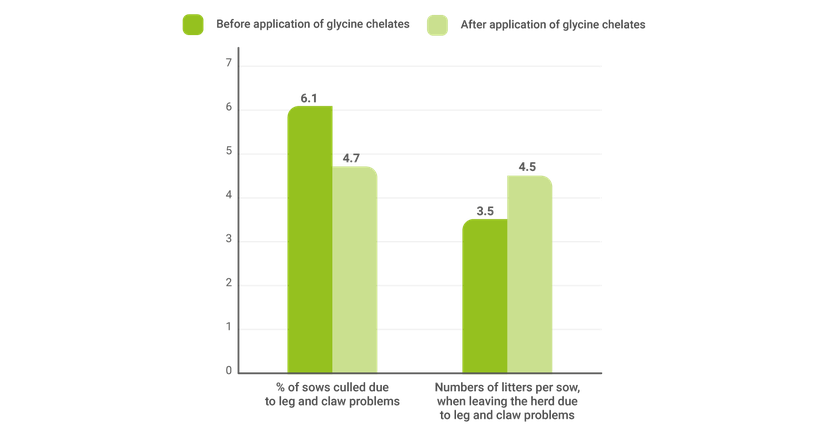 Figure 6: Lower replacement rate and higher longevity of sows after adding glycine chelates (E.C.O.Trace®) to the diet.
Conclusion.
Claw health of dairy cows and sows is highly relevant for animal well-being and the farm’s economic benefit. Organically bound trace minerals are an important factor in feeding strategies to optimize claw health which also supports general animal health and high performance. Please contact a Biochem expert or visit our website to learn more about our product portfolio.
References are available upon request.


