Biochem
Products
Biochem
gmp+

GMP+ (FSA)

Feed Safety

A Futter

A-Futter

Quality Management

EG OKO

EG-Öko

Organic Feed

QS Feed Safety

QS

Feed Safety

GMP+FRA

GMP+ (FRA)

Quality Management

ISO 50001

ISO 50001

Energy Management

ISO 9001

ISO 9001:2015

Quality Management

VLOG

VLOG

Quality Management

EvoVadis

EcoVadis

Sustainability

Let’s Connect:LinkedInFacebookYoutube

Links

  • About Us
  • Contact Us
  • Careers
  • FAQs
  • Articles
  • Press Releases
  • Environment and Safety
  • Whistleblower Platform

Products

  • All Products
  • TechnoSpore®
  • B.I.O.Tox® Activ8
  • E.C.O.Trace® Iron
  • BetaTrace® Iron
  • TechnoYeast
  • LiquiTonic LC

Animal Species

  • Ruminants
  • Poultry
  • Swine
  • Aquaculture
  • Companions

Legal

  • Imprint
  • Privacy Policy
  • Terms & Conditions

© 2025, Biochem Zusatzstoffe Handels- und Produktionsgesellschaft mbH

  • ImprintPrivacy PolicyTerms & Conditions
  1. Home
  2. News
  3. Articles
  4. Consumo de Ração Primeiro – A Prioridade Máxima.

Consumo de Ração Primeiro – A Prioridade Máxima.

Published on: March 31, 2026
Author: Biochem Team
Time: 6 min read
Share on:
Loading article content for text-to-speech...

Feed intake first - The top priority in weaning strategies!

The weaning process poses a major challenge for young piglets and requires careful management to minimize stress and support health to make this critical phase as comfortable as possible for the piglets, ensuring the best possible profitability. Tools such as functional, yeast-based feed materials can naturally aid piglets during this transition.

Weaning and its impact on young piglets

Weaning exposes piglets to major nutritional, environmental, social, and physiological stress.  Piglets get separated from the sow, get moved to a new environment, and are confronted with high pathogen pressure and unfamiliar microbes. At the same time, their immune system is still immature, increasing their susceptibility to infections. These stress factors can disrupt gut health and functionality by causing microbial imbalance, inflammation, villous atrophy, and increased intestinal permeability, which often leads to post-weaning diarrhea, especially in the first week. In addition, piglets must adapt to unfamiliar solid feed while their digestive system is still developing. Consequently, weaning is one of the most challenging phases in a pig’s life, often resulting in reduced feed intake, health problems, and impaired growth.

The gastrointestinal tract plays a central role in the health of young piglets: it is responsible for feed digestion and nutrient absorption, regulates fluid balance, and supports enzyme and antibody secretion, while also serving as a critical barrier against pathogens. With around 70% of the immune system located in the gut, its condition largely determines how well a piglet can cope with the stress of weaning. Careful management - particularly the timing of weaning and the design of the right feeding strategy - is therefore essential to minimize weaning-related problems.

Boosting feed intake - The cornerstone of successful weaning

Separation from the sow is accompanied by a diet change. Piglets must adapt from the tasty and easily digestible sow’s milk to a solid feed that is less palatable and challenging to digest. This, of course, leads to a loss of appetite and reduced feed intake, which negatively affects intestinal morphology, digestion, and nutrient supply. Finally, reducing the piglets’ energy supply. Conversely, this condition does not increase appetite, of course - it's a vicious cycle.

To stabilize intake, feed should contain generally high-quality ingredients free from molds and oxidative damage, with balanced energy and nutrient density. The diet should provide the right proportion of amino acids, vitamins, minerals, fats, and fibers to meet piglets’ needs. Feed digestibility, which is closely linked to passage rate, is also a key factor influencing feed intake, along with the physical characteristics of the feed. Additive tools, such as palatable proteins (e.g., sweet milk proteins, porcine blood plasma), sweeteners, flavors, phytogenic additives or umami taste enhancers are also known to promote intake. Despite their proven benefits, effective tools like porcine blood plasma and pharmacological ZnO are facing declining acceptance or even regulatory restrictions. This has driven interest in natural alternatives, with yeast-based products showing promise in supporting feed intake, gut health, and immunity.

TechnoYeast uncovered – What’s in it and why it matters

TechnoYeast, derived from Kluyveromyces fragilis, is a functional feed ingredient that supports feed intake and promotes gut health, growth, and vitality in piglets, with effects comparable to or exceeding those of e.g., porcine blood plasma. Rich in functional, umami-tasting amino acids such as glutamic acid and aspartic acid, RNA-derived nucleotides, and digestible di- and tripeptides, it provides an effective combination for enhancing feed palatability, immunity, and gut health. Its yeast cell wall components, including mannan-oligosaccharides and β-glucans, contribute to gut health by reducing pathogens and stimulating the immune system.

Figures 1–3 illustrate the beneficial effects of TechnoYeast on weaned piglets fed at the recommended dosage for approximately 14 days. The figures summarize results from multiple trials assessing average feed intake, average daily gain, and average feed conversion ratio over a 42-day post-weaning period. Separate overviews are shown for trials in which porcine blood plasma was totally or partially replaced by TechnoYeast, and for trials comparing TechnoYeast with a commercial control diet without yeast. TechnoYeast showed equivalent performance to blood plasma, indicating its suitability as a replacement, and improved all parameters compared with the control diet, demonstrating positive effects on appetite, gut health, and overall functionality.

Exploring the taste-enhancing components

Glutamic acid and its salts (glutamates) are widely used as flavor enhancers in food and feed due to their functional and nutritional benefits. They primarily stimulate the umami taste, also known as “savory”. Aspartic acid also contributes to umami, but to a lesser extent. Piglets particularly like this taste because it signals high protein content, important for growth. In piglet nutrition, glutamic acid supports metabolism, immunity, protein synthesis, neurotransmission, and intestinal mucosa maintenance for gut balance.

5′‑Ribonucleotides, especially guanosine 5′‑monophosphate from yeast, can enhance umami taste. Although nucleotides alone have a mild flavor, they act synergistically with glutamic acid to amplify the umami signal at taste receptors, thereby increasing feed appeal. Beyond taste, nucleotides are important for tissues with high cell turnover, supporting gut function and immune defense in young animals.

However, feed palatability is not determined solely by the presence of single valuable amino acids or nucleotides. The structure of these proteins also affects taste, as di- and tripeptides - unlike free amino acids - are particularly known for providing an umami flavor. The product’s origin also plays a key role in flavor. By-products such as ethanol or brewer’s yeasts often negatively impact taste, with production residues producing sour or bitter notes. In contrast, primary yeast imparts pleasant yeast or cereal notes, while the unique Kluyveromyces fragilis delivers a distinct milky-umami flavor.
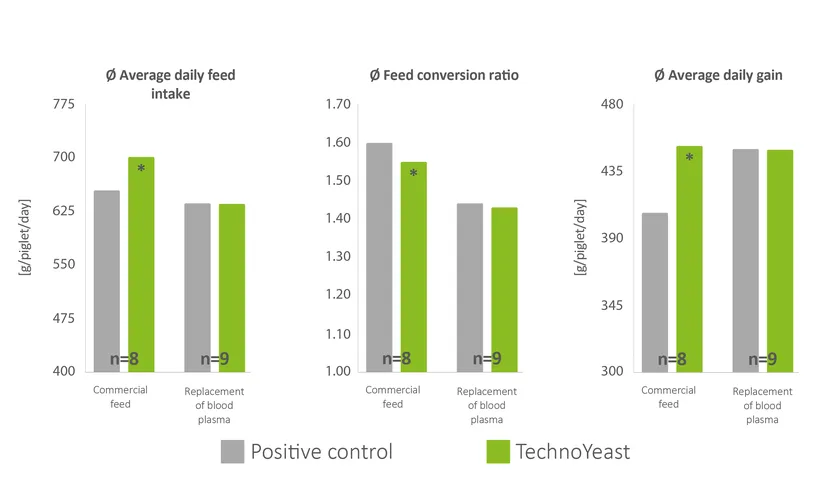
Figure 1-3: Effects of TechnoYeast at recommended dosage in prestarterFigure 1-3: Effects of TechnoYeast at recommended dosage in prestarter (~14d) on performance in the total weaning phase (~42d) compared to a non-treated control or a fully/ partly blood plasma replacement [Meta analysis by Biochem Research; *significant (p<0.05) differences between the groups in the individual feeding trials]

In a nutshell

Weaning is the most critical and challenging period in a piglet’s life, posing multiple stressors that often result in reduced feed intake, impaired gut function, and slowed growth. Supporting feed intake during this stage is vital for maintaining both intestinal and overall health. TechnoYeast, a palatable functional feed ingredient derived from the yeast strain Kluyveromyces fragilis, has been shown to help support appetite and gut health in weaning piglets.

More Articles

Feed Intake First – The Top Priority.

Feed Intake First – The Top Priority.

The weaning transition is a critical window for piglet development. When feed intake drops, gut integrity follows, creating a cycle of poor performance. Our latest research explores how the umami-rich profile of Kluyveromyces fragilis provides a stable, natural foundation to maintain appetite and support immunity during this high-stress period.

Share on:
Securing the Future of Dairy Performance with Rumen Bypass Betaine.

BetaTrace®: Securing the Future of Dairy Performance with Rumen Bypass Betaine.

A betaína padrão é frequentemente perdida devido à degradação no rúmen, limitando sua capacidade de apoiar as vacas em transição quando elas mais precisam. BetaTrace® supera esse desafio ao complexar a betaína com minerais orgânicos, permitindo que ela contorne o rúmen e apoie efetivamente a saúde e o metabolismo do fígado. Descubra como esse aditivo de dupla ação aumenta a disponibilidade de metionina e melhora o desempenho da lactação, ao mesmo tempo em que fornece minerais essenciais.

Share on:
Managing Mycotoxins: Real Stories, Real Solutions.

Managing Mycotoxins: Real Stories, Real Solutions.

Quando um suinocultor enfrentou uma instabilidade inexplicável em seu rebanho de matrizes. Os adsorventes comuns a base de zeolita não solucionaram o problema. Leia como a mudança para B.I.O.Tox® Activ8 restaurou o desempenho reprodutivo e melhorou o número de leitões desmamados em um ensaio de campo de seis meses.

Share on:
Time to Rethink Weaning: Why Smarter Strategies Deliver Stronger Biological and Economic Outcomes in Dairy Calves.

Time to Rethink Weaning: Why Smarter Strategies Deliver Stronger Biological and Economic Outcomes in Dairy Calves.

Encarar a criação de novilhas apenas como um centro de custos é ignorar seu potencial como um grande investimento na produtividade futura do seu rebanho. A fase de desmame é particularmente crítica; erros nessa fase podem anular os ganhos iniciais e reduzir permanentemente a produção de leite ao longo da vida. Descubra como facilitar o desmame e proteger seu investimento com RumiPro® Wean.

Share on:
Day-Old Chick Quality: Why is it an important topic?

Day-Old Chick Quality: Why is it an important topic?

Descubra por que a qualidade dos pintos de um dia se tornou o fator decisivo no volátil mercado avícola atual. Saiba como as primeiras horas após a eclosão podem determinar o potencial de desempenho de todo o seu lote e porque os principais produtores estão implementando protocolos especializados de suporte inicial. Descubra estratégias comprovadas cientificamente que podem melhorar drasticamente a qualidade e a rentabilidade dos seus pintos de um dia (DOC).

Share on:
Managing Large Litters

Managing Large Litters.

O progresso na reprodução resultou em ninhadas maiores, mas não sem custos. As metas de reprodução das porcas mudaram nas últimas décadas, com foco na seleção de taxas de ovulação mais altas e ninhadas maiores. Isso não apenas aumenta a demanda e a pressão sobre as porcas, mas também aumenta a variação no peso ao nascer, a competição pelo úbere e as perdas antes do desmame. Este boletim informativo explica maneiras práticas e baseadas na ciência para apoiar a saúde das porcas, o fornecimento de colostro e leite e os cuidados iniciais com os leitões. Você também verá como a entrega à base de água e os conceitos de alimentação individualizada na fazenda podem aumentar a uniformidade e o sucesso do desmame.

Share on:
TechnoSpore® in Broilers: A Meta-Analysis.

TechnoSpore® in Broilers: A Meta-Analysis.

A produção moderna de frangos enfrenta desafios únicos devido ao rápido crescimento e à alta suscetibilidade a doenças. Descubra como TechnoSpore®, um probiótico à base de Bacillus coagulans DSM 32016, aumenta a eficiência da produção, melhorando a saúde intestinal e a digestibilidade da ração. Apoiado por estudos extensivos envolvendo mais de 3 milhões de aves, TechnoSpore® oferece resultados mensuráveis que podem melhorar significativamente o desempenho do seu rebanho.

Share on:
Mycotoxins: A Pervasive Challenge.

Mycotoxins: A Pervasive Challenge.

As micotoxinas representam uma ameaça silenciosa, mas generalizada, à alimentação animal e à saúde do gado em todo o mundo. Descubra como esses perigos ocultos se desenvolvem, por que a contaminação múltipla é uma preocupação crescente e os métodos avançados essenciais para uma detecção precisa. Saiba como a Biochem enfrenta esses desafios e descubra o que é possível fazer com a análise de micotoxinas, incluindo estratégias personalizadas para proteger o bem-estar animal e a lucratividade.

Share on:
Rethinking Trace Minerals: Healthier Shrimp, Cleaner Planet with E.C.O.Trace®.

Rethinking Trace Minerals: Healthier Shrimp, Cleaner Planet with E.C.O.Trace®.

Os minerais traço são vitais para o desempenho máximo dos seus animais, mas como podemos garantir sua ingestão ideal sem prejudicar o planeta? A suplementação tradicional pode levar a um desperdício significativo de minerais e a preocupações ambientais. Descubra como E.C.O.Trace® minerais traço orgânicos oferecem uma solução mais inteligente, melhorando a absorção para proporcionar uma saúde melhor aos camarões com menos impacto ambiental. É hora de alcançar mais com menos para um futuro sustentável na nutrição de camarões.

Share on:
Smooth Transitions: Choline’s Secret to Dairy Success

Smooth Transitions: Choline’s Secret to Dairy Success.

Você sabia que suplementar suas vacas leiteiras com colina pode melhorar significativamente a produção de leite e a saúde do rebanho durante o período crítico de transição? Descubra como RumiPro® Chol ajuda as vacas a gerenciar com eficiência as mudanças nutricionais, reduzindo o risco de esteatose hepática e melhorando o desempenho geral, beneficiando tanto as vacas quanto seus bezerros. Saiba mais sobre como a colina pode otimizar o sucesso do seu rebanho!

Share on:
How Yeast Cell Walls Are Shaping the Future of Poultry Production

How Yeast Cell Walls Are Shaping the Future of Poultry Production.

A produção de aves está aumentando para atender às necessidades de proteína de uma população global em rápida expansão. Com as restrições aos antibióticos e a pressão dos patógenos levando as aves aos seus limites, a saúde intestinal agora é essencial para o sucesso. Descubra como as paredes celulares de leveduras, como a TechnoMos®, estão transformando o desempenho das aves, apoiando a resistência a doenças e aumentando a produtividade.

Share on:
Navigating Weaning Challenges: Optimizing Piglet Health and Performance

Navigating Weaning Challenges: Optimizing Piglet Health and Performance.

O desmame pode ser um momento decisivo para a saúde e o desempenho dos leitões. Saiba como é a saúde intestinal e como o processo de desmame afeta os leitões. Descubra como estratégias nutricionais específicas, incluindo prebióticos, probióticos e outros, podem minimizar o estresse, apoiar a saúde intestinal e preparar o caminho para uma transição tranquila e um crescimento ideal.

Share on:

Subscribe to our Newsletter.

Stay in the loop! Get educational insights and product news delivered right to your inbox. Sign up for our quarterly newsletter today!