Maximize Dairy Production with FreshControl: Keeping it Cool, Keeping it Nutritious.
100 years ago, the feeding of dairy cows looked very different. Early guidelines for feeding concentrates were often based on a simple conversion—1 kg of concentrate for every 2 kg of milk produced. Total mixed rations (TMR) as we know them today did not exist and are, in fact, an invention of the latter half of the last century.
A Paradigm Shift in Dairy Cow Feeding
On the surface, the concept is simple. A method of feeding dairy cows that helps them achieve maximum performance. In a true TMR, each mouthful of feed contains a consistent, definable, and—as close as you can get to it—nutritionally complete diet.
TMR feeding allows cows to be grouped based on nutritional needs and can reduce the sorting of individual feeds by cows based on individual taste preferences. This results in a more stable and ideal environment for rumen microbes and ultimately improved feed efficiency. Silages often make up the largest proportion of the various ingredients used to form TMR.
Silage: The Foundation of TMR
Silage has been used as feed for ages. Good quality silage is highly palatable and nutritious and can be stored for long periods of time. However, silage quality depends on many factors, including crop maturity, moisture content, chop length, and temperature. Ensiling—the process of fermenting feed—typically involves four main phases: aerobic, fermentation, stable, and feedout.
The aerobic phase occurs in the first 2–4 days. During this time, aerobic bacteria consume the oxygen in the feed, producing heat and carbon dioxide and creating an anaerobic environment. The fermentation phase takes place approximately 4–14 days after covering. During this phase, lactic acid and acetic acid are produced, resulting in a drop in pH.
The storage phase begins at about 2–3 weeks. During this phase, the fermentation process slows down and the silage is stable. The pH remains low, and the feed is protected from spoilage. The final phase is the feeding phase. At this point, the silage is exposed to oxygen. Microbial activity can increase, leading to a restart of the fermentation process and spoilage (Figure 1).
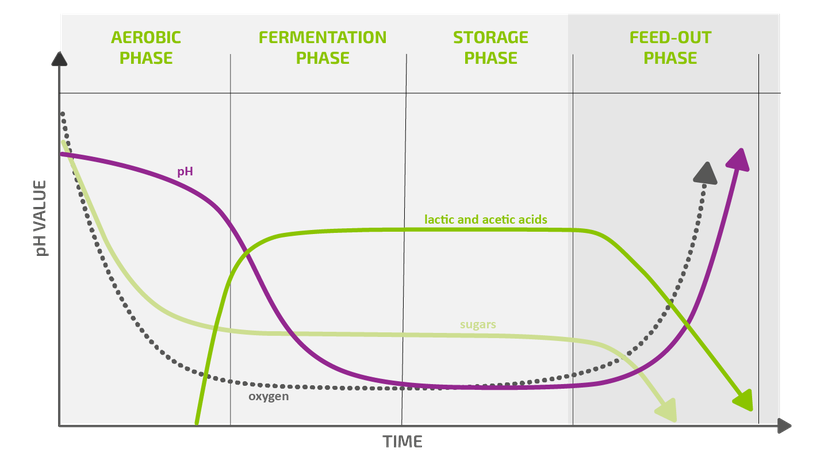 Figure 1: An overview of the process of ensiling. Lactic acid and acetic acid producing bacteria use up the available sugar and produce organic acids. The release of organic acids works to lower the pH of the silage. Once the sugar and oxygen have been used up, fermentation ceases and the silage remains stable. With the exposure to oxygen during the feed-out stage, organic acids are degraded, microbial activity increases, and the pH rises.
The Perils of Reheating in TMR
However, even using stable silage can cause unstable TMR. The actual process of making TMR exposes all feed components to air during mixing, which can trigger the reheating process. Sometimes leftover TMR from previous mixes can harbor high numbers of aerobic microbes. Even a small amount of residual TMR added to a new TMR can greatly reduce its aerobic stability and should therefore be avoided at all costs.
The aerobic stability of TMR varies greatly depending on the environment, temperature, formulation, and additional ingredients. Because of the frequently high starch and sugar content, TMR can easily reheat at high ambient temperatures, resulting in nutrient and palatability losses. Researchers have reported that when incubated at 22°C, over 50% of TMR reheats in less than 12 hours. This means that TMR can spoil in the feed bunk even when fed twice a day.
Some methods to reduce reheating include minimizing TMR mixing time, maintaining mixer temperature, prompt TMR feeding, and regular feeder cleaning. An additional method is to use preservatives—usually organic acids. These work by inhibiting microbial growth that can spoil the TMR and reduce its nutritional value.
Understanding the Chemistry of Organic Acids
To understand how organic acids work, we need to explore the chemistry behind them. Organic acids occur naturally in plant and animal tissues. They can also be formed by microbial fermentation of carbohydrates, most commonly in the colon. They are a diverse group of compounds that contain a carboxyl group (-COOH), which is responsible for their acidic properties.
Organic acids are often used for their antimicrobial effects, which depend on their ability to dissociate in aqueous environments and lower the pH. This results in two main effects. The first is the effect on the environment in which the microbe exists. Most microorganisms have an optimal pH range for growth. If the pH of their environment falls below this range, growth and replication will cease. In fact, pH changes caused by organic acids are the mechanisms behind good silage.
The second key principle about the effect of organic acids on microbial is that only the non-dissociated—or non-ionized—form of an organic acid can penetrate the walls of microorganisms and disrupt normal physiology. Once inside, organic acids dissociate into hydrogen ions (H+) and anions (–COO-), disrupting biochemical processes. As the intracellular pH drops, the pathogen uses valuable energy to pump out hydrogen ions and restore the proper pH. Eventually, the pathogen cannot keep up with this energy demand, resulting in growth inhibition or even cell death.
Organic acids can denature proteins, which are essential for many enzymes and structural components in cells. Because denatured proteins lose their natural shape, they are unable to perform their original functions. This can disrupt energy production, DNA replication, nutrient uptake, and other essential cellular activities.
The negatively charged anions of organic acids can interact with the negatively charged phospholipid bilayers of bacterial cell membranes. This interaction can disrupt the membrane structure, leading to leakage of essential cellular components and compromising the integrity of the microbe (Figure 2).
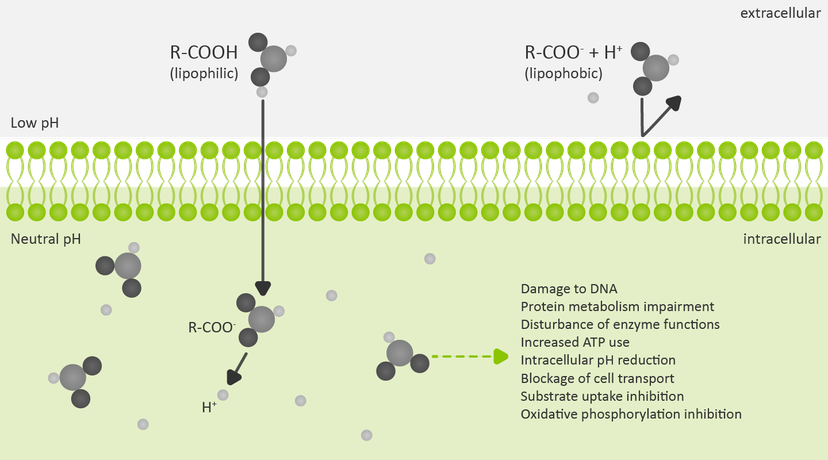 Figure 2: Undissociated acids can pass through the lipid layer of the microbe. Once inside, the acid dissociates and can change cell physiology, ultimately resulting in decreased replication or growth inhibition.
Combat Microorganisms With Salts of Organic Acids
Organic acids such as benzoic acid, sorbic acid, propionic acid, acetic acid, lactic acid, and their mixtures are widely used as preservatives and sanitizers in many industries. Some are more effective against bacteria, others against mold or yeast. However, the corrosive nature of the pure acids limits their use.
As a result, salts of these acids (e.g., sodium, potassium, or calcium salts) are widely used. Salts are not corrosive, which makes them easier to handle and use in equipment. Under acidic and humid conditions, salts of organic acids are converted to biologically active acids and have the same antimicrobial effects as the corresponding acid.
For example, in the right environment, potassium sorbate loses its potassium allowing the undissociated form of sorbic acid to passively diffuse through the cell membrane of pathogenic microorganisms. Inside the cell, sorbic acid dissociates and damages the cell membrane, inhibits enzymes, amino acid uptake, and RNA and DNA synthesis. As a result, the pathogen is unable to replicate.
A similar pattern is seen with propionic acid, derived from calcium propionate. Propionic acid interferes with electrochemical gradients in the cell membrane, disrupts cellular transport processes, and inhibits the uptake of substrate molecules. This results in inhibition of microbial growth and preservation of nutrients and palatability.
FreshControl: A Powerful Combination of Organic Acids
New EU legislation in April 2023 reduced the maximum allowed level of sorbic acid in complete feed, to take effect in early 2024. To meet these requirements, FreshControl has been reformulated to synergistically combine the preservative effects of two salts of organic acids to prevent microbial spoilage and nutrient loss in TMR.
FreshControl’s combination of these two salts—potassium sorbate and calcium propionate—develops its antimicrobial effect only once mixed into the TMR, when the two salts are converted into sorbic acid and propionic acid. Both acids have significant antifungal activity and complement each other by inhibiting the growth of bacteria and yeast.
The newly formulated FreshControl was tested in two separate trials and demonstrated its superior ability to control reheating and maintain aerobic stability. In one of these studies, FreshControl (2 g/kg) was tested against a control for signs of reheating. Freshly prepared TMR was placed into two 4-liter buckets. One bucket contained only the TMR (control) and a second bucket contained the TMR mixed with 2g/kg FreshControl. Both buckets were placed outdoors in the shade at ambient temperatures (average 23.8°C; 16.7°C–29.5°C) for 30 h. Each bucket was divided into 4 quarters where the hourly temperature was measured, and the results averaged (Figure 3). Throughout the test period, and despite a sharp increase in ambient temperature, 2 g/kg FreshControl added to fresh TMR prevented reheating.
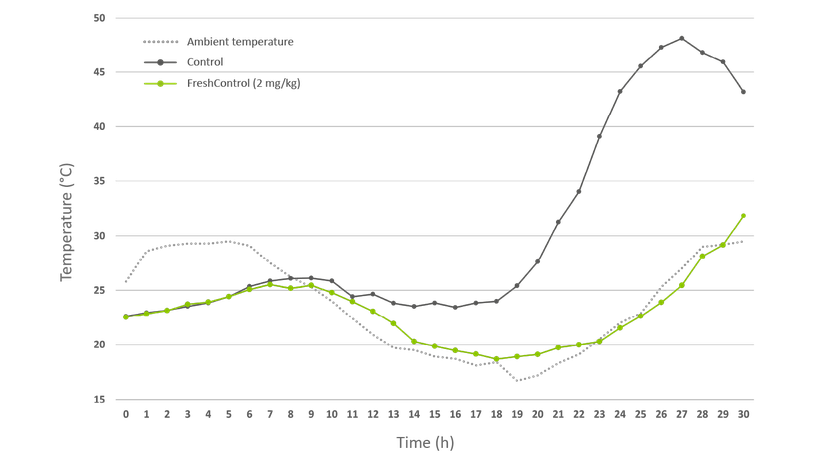 Figure 3: Temperature measurements of TMR treated with 2 g/kg FreshControl closely followed the ambient temperature curve over the 30-h trial period whereas the control TMR showed no further cooling after 14 h. At 23 h, the FreshControl treated TMR was almost 50 % cooler than control.
FreshControl effectively tackles the challenges of aerobic stability in TMR. Don’t let spoilage compromise your TMR’s quality. Say goodbye to spoilage and nutrient loss and embrace the freshness and stability that FreshControl delivers. Keep it cool with FreshControl!


