Milk Fever: Old Hat or constantly New Insights?
Milk fever is one of the most common diseases in fresh calved cows. Preventive measures have been widely discussed in the past, but what really helps? What new findings are out there? Can hypocalcemia affect all cows?
Milk fever? Facts and risks.
Did you know? A cow needs up to 80 g calcium per day after calving; up to 50 % of the animals in a herd can be affected by subclinical milk fever; animals are primarily affected in second or higher lactation.
Milk fever is caused by an increased calcium requirement at the onset of lactation. Prior to calving, a cow needs about 18 g calcium per day. For colostrum production, however, 50 g per day is needed, and at the peak of lactation up to 80 g per day. This quadrupling of the calcium requirement must be balanced by the animal’s metabolism. When this does not happen quickly enough or calcium is only available in insufficient quantities, hypocalcemia can result.
Animals initially show a subclinical form of milk fever, without visible symptoms. If the blood calcium level continues to decrease, this can lead to a clinical form of the disease. However, not all animals are affected in the same way. One of the biggest risk factors is the lactation number. Almost all cases of milk fever affect animals in the second or subsequent lactation. One explanation for this is the higher milk yield of multiparous cows, which also increases the daily calcium requirement. Additionally, older animals exhibit a lower sensitivity to calcium regulation mechanisms. Another risk factor is the conditioning of the animals. Over-conditioned animals show signs of milk fever much more often compared to animals with an optimal body condition score (BCS). External factors also play a role and can increase the risk for milk fever. These include feeding and diet formulation, dry cow management and other diseases that may occur.
Consequences of calcium deficiency.
Animals affected by clinical milk fever show visible symptoms, such as:
Wobbly or stiff gait
Cold limbs and ears
Reduced chewing
Changed laying behavior, inability to stand
These symptoms can be explained by the important role of calcium in the transmission of stimuli in the muscles and nerves. The muscular system can no longer work properly if calcium is deficient in the metabolism. This results in flaccid paralysis of the affected muscles.
Greater damage—especially from an economic standpoint—is caused by subclinical hypocalcemia. The risk of contracting other diseases increases significantly when the calcium level falls below a certain threshold level. Figure 1 shows the risk of other typically occurring diseases accompanying diagnosed subclinical milk fever.
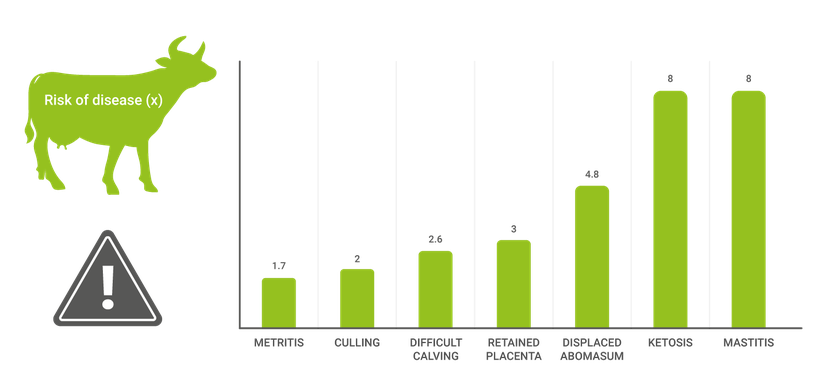 Figure 1: Relative risk of typical fresh-cow diseases in combination with diagnosed subclinical hypocalcemia (Hendricks, 2010).
The main reason for an increase in the risk of disease is the change in the animals’ general behavior resulting from muscular impairment. For example, a 25 % reduction in the blood calcium level can lead to a complete standstill of ruminal activity. This reduces the nutrient supply to animals that are already weakened by calving and increases their susceptibility to diseases.
Better safe than sorry! How to effectively prevent milk fever.
Did you know?... Milk fever prevention measures can be divided into three categories... Different sources of calcium help to varying degrees in the prevention of milk fever... The optimal solution depends to a great extent on the specific farm situation.
In addition to immediate treatment of clinical cases by experienced veterinarians, the right preventive strategies play a key role. These can be divided into three categories:
1) Long-term solutions for the entire herd.
Long-term prevention solutions are primarily aimed at adjusting the feed ration. For example, by limiting the calcium content in the dry ration, the metabolism can be “trained” to provide calcium and be better prepared for the period of higher demand. This, however, requires precise knowledge of the ingredients in the feed used. The native calcium levels in commonly used feed often make this strategy difficult.
The use of acidic salts has proven to be a successful strategy. This causes a mild metabolic acidosis in the animal, which also trains the regulatory mechanisms for calcium. The amount of salt used must be strictly controlled. Due to poor palatability, excessive amounts of salt can lead to a reduction in feed intake. At the same time, an excessive lowering of the blood pH-value is also not sensible from a nutritional point of view. This strategy can be controlled by the content of cations and anions in the ration and by checking the pH value in the animals' urine. It gives a good overview of the cation-anion balance in the animal.
2) Medium-term support strategies.
In the medium term, an attempt can be made to increase feed intake as quickly as possible after calving. This will improve the animals’ nutrient supply. It also makes sense to adjust the body condition of the animals at the time of calving. A BCS of 3.25 to 3.5 is an ideal target. Both measures have the advantage that they can be helpful in the prevention of other diseases too. It is important to point out that these are only support strategies. On their own, they are unable to alleviate the problem of hypocalcemia.
3) Animal-specific short-term measures.
Short-term solutions offer the widest range of support options. In clinically diseased, downer cows, calcium infusion is necessary to quickly bridge the calcium deficit. The use of a vitamin D3 injection is also widespread. Vitamin D3 plays an essential role in calcium metabolism and ensures higher calcium absorption and mobilization. However, the timing and quantity of the application are key factors. If the injections are administered too early or too late, the effect will dissipate. Administration 2 – 5 days prior to calving has proven to be ideal. The quantity also poses a challenge. If the amount is too low, the desired effect will not be achieved. If it is too high, there is a risk of hypervitaminosis.
As a preventive measure, it is advisable to orally administer calcium preparations. These products work quickly and can provide targeted support. This depends, however, on the amount of calcium administered, the type of calcium sources, and the method of application. Biochem recently carried out extensive research to examine the effect of common calcium sources. Figure 2 shows the results of some of the sources studied.
 Figure 2: Calcium blood level of fresh-calved cows depending on three different oral calcium application (T1 = gel containing calcium chloride, T2 = gel containing calcium acetate & calcium propionate, Cal Gel = combination of all three calcium sources) (Biochem, 2018).
It is clear that different sources have different effects on the blood calcium level. This means that they contribute differently to the prevention of subclinical milk fever. The combination of several calcium forms in orally administered calcium products has proven to be effective.
Is milk fever a thing of the past? By no means!
Although milk fever has been much discussed, it is still a very relevant issue and will become increasingly acute as the performance level of dairy cows increases. The pathophysiological circumstances of the disease and the associated problems have been largely clarified. But the corresponding prevention strategies will continue to develop and improve.
In general, the various prevention measures must be suitable for the specific farm. For example, adjusting and controlling the ration in detail is not possible for each farm. At the same time, individual animal strategies alone may not be the optimal solution for large farms. In many cases, external factors are impossible to control or regulate in the short term. A combination of different measures is recommended, depending on the severity of the problem on the respective farm. The aim of any milk fever prophylaxis should be to reduce the frequency and severity of cases. This is the only way to ensure the animals remain healthy and productive. This also improves the profitability of farming operations.


